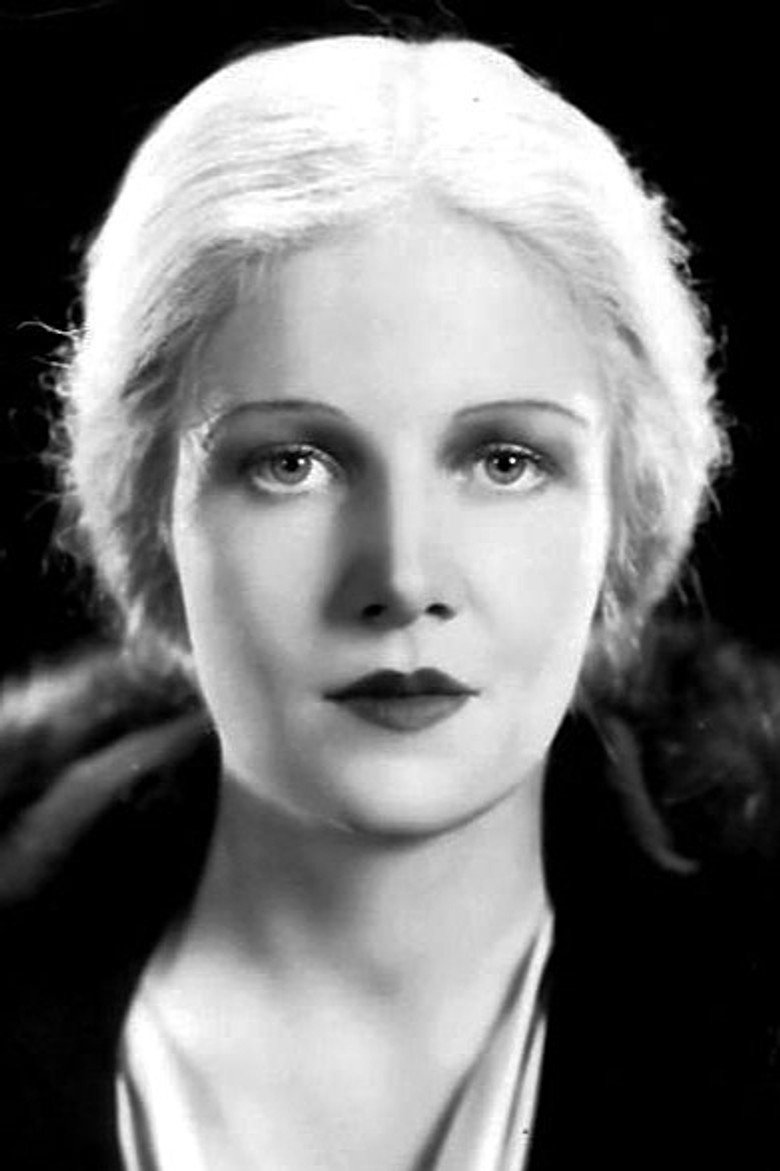
Ann Harding
Ann Harding (born Dorothy Walton Gatley; August 7, 1902 – September 1, 1981) was an American actress. A regular performer on Broadway and in regional theater in the 1920s, she gained fame in film with the rise of the new medium of "talking pictures". Harding was nominated for the Academy Award for Best Actress for Holiday (1930). She was also prolific in radio and television, and has two stars on the Hollywood Walk of Fame, for film and television each.
Main movies and TV shows
- Alfred Hitchcock Presents (1955) — Sarah Hale
- It Happened on Fifth Avenue (1947) — Mary O'Connor
- Peter Ibbetson (1935) — Mary, Duchess of Towers
- The Man in the Gray Flannel Suit (1956) — Helen Hopkins
- Eyes in the Night (1942) — Norma Lawry
- The North Star (1943) — Sophia Pavlov
- The Animal Kingdom (1932) — Daisy
- Holiday (1930) — Linda Seton
- Mission to Moscow (1943) — Marjorie Davis
- Double Harness (1933) — Joan Colby Fletcher
- Dr. Kildare (1961) — Mae Priest
- When Ladies Meet (1933) — Clare Woodruff
- East Lynne (1931) — Lady Isabella
- Condemned! (1929) — Madame Vidal
- Christmas Eve (1947) — Aunt Matilda Reed
- Ben Casey (1961) — Edith Sommers
- The Unknown Man (1951) — Stella Masen
- Two Weeks with Love (1950) — Katherine Robinson
- Love from a Stranger (1937) — Carol Howard
- Burke's Law (1963) — Annabelle Rogers
Facts
- Born: August 7, 1902
- Place of birth: Fort Sam Houston, United States
- Died: September 1, 1981, Sherman Oaks, United States, aged 79
- Nationality: United States
- Occupations: Actress
- Languages: English
- Education: Bryn Mawr College, East Orange High School
Family
- Spouse: Werner Janssen, Harry Bannister
Detailed biography
Early years
Harding was born Dorothy Walton Gatley at Fort Sam Houston in San Antonio, Texas to George G. Gatley, a career army officer, and Elizabeth "Bessie" Walton (Crabb) Gatley. After travelling often during her early life because of her father's military career, she grew up in East Orange, New Jersey, graduated from East Orange High School, and attended Bryn Mawr College. Her father "violently opposed her profession," so Harding changed her name when she began her acting career.
Career
Harding initially desired a business career and accepted a secretarial position with the Metropolitan Life Insurance Company. Her work included dictating letters, and upon discovering that the company's best typists would claim the best Dictaphone recordings so they could produce the most accurate letters, Harding worked to develop tone, cadence, and diction that would produce easy to understand recordings. Her success with the Dictaphone led to work as a script analyst, which required her to review plays and movie scripts and provide recorded oral summaries. These recordings led to acting work, and she made her Broadway debut in Like a King in 1921. Three years later she found her "home theater" in Rose Valley, Pennsylvania, after being directed by Hedgerow Theatre founder Jasper Deeter in The Master Builder. Over the years she returned to Hedgerow to reprise several of her roles. She was a prominent actress in Pittsburgh theatre for a time, performing with the Sharp Company and later starting the Nixon Players with Harry Bannister. In 1931, she purchased the Hedgerow Theatre building from Deeter for $5,000 and donated it to the company.
In 1929, she made her film debut in Paris Bound, opposite Fredric March. With talking pictures becoming the standard, producers and directors discovered that Harding's diction and pace of speech worked well with the new sound recording technology, and she soon became a leading lady. Harding's performances were often heralded by critics, who cited her stage experience for enabling her to give her characters depth.
First under contract to Pathé, which was subsequently absorbed by RKO Pictures, Harding was promoted as the studio's 'answer' to Metro-Goldwyn-Mayer's superstar Norma Shearer. She co-starred with Ronald Colman, Laurence Olivier, Myrna Loy, Herbert Marshall, Leslie Howard, Richard Dix, and Gary Cooper, and was often on loan to other studios, such as MGM and Paramount. At RKO, Harding, along with Helen Twelvetrees and Constance Bennett, comprised a trio who specialized in the "women's pictures" genre. She soon became a leading lady; she kept in shape by using the services of Sylvia of Hollywood.
In Harding's second film, Her Private Affair, she portrayed a wife of questionable morality, and the film was a commercial success. During this period, she was generally considered to be one of cinema's most beautiful actresses, with her waist-length blonde hair being one of her most noted physical attributes. Films during her peak include The Animal Kingdom, Peter Ibbetson, When Ladies Meet, The Flame Within, and Biography of a Bachelor Girl. Harding, however, eventually became stereotyped as the innocent, self-sacrificing young woman. Following lukewarm responses by both critics and the public to several of her later 1930s films, she eventually stopped making movies after she married the conductor Werner Janssen in 1937. She returned to the big screen in 1942 to make Eyes in the Night and to take secondary roles in other films. She played "Mary," the estranged wife of Charlie Ruggles, in the Christmas film It Happened on Fifth Avenue in 1947. In 1956, she again starred with Fredric March in The Man in the Gray Flannel Suit.
The 1960s marked Harding's return to Broadway after an absence of decades—having last appeared in 1927. In 1962, she starred in General Seeger, directed by and co-starring George C. Scott, and in 1964 she appeared in Abraham Cochrane ("her last New York stage appearance"). Both productions had brief runs, with the former play lasting a mere three performances (including previews). Harding made her final acting performance in 1965 in an episode of television's Ben Casey before retiring.
Death
On September 1, 1981, Harding died at the age of 79 in Sherman Oaks, California.
She was survived by a daughter, named Jane Otto, and four grandchildren.
Recognition
Harding was honored with a block in the forecourt of Grauman's Chinese Theatre on August 30th, 1930.
Harding was nominated for the Academy Award for Best Actress for Holiday in 1931.
For her contributions to the motion picture and television industries, Harding has two stars on the Hollywood Walk of Fame—one in the Motion Pictures section at 6201 Hollywood Boulevard and one in the Television section at 6850 Hollywood Boulevard. The ceremony for both stars was held on February 8, 1960.
As of October 7, 2023, there is a plaque memorializing Ann Harding inside Hedgerow Theatre.
Personal life
Harding was married twice, her husbands being:
Harry Bannister, an actor. They married in 1926 and divorced in 1932 in Reno, Nevada. A New York Times article (May 8, 1932) about the divorce stated that the actress still loved her husband and only agreed to a divorce to help Bannister's stymied career. "The proceedings were among the most unusual in the history of Nevada's liberal divorce laws," the newspaper reported. "Only through dissolution of their marriage could he escape, they said, from being overshadowed by Miss Harding's rise to stardom." The divorce also resulted in what was described as "a bitter court fight... over custody of their daughter", Jane Harding (1928–2005, married name Jane Otto). According to an interview with Harding's biographer, Scott O'Brien, Jane Harding said, "I had a terrible childhood. I hated my nurse. I never saw mother. She was always busy."
Werner Janssen, the conductor. Harding and Janssen married in 1937 and divorced in 1963, with Harding claiming that her husband had controlled her throughout their marriage, keeping her from her friends and isolating her from the world. By this marriage, Harding had two stepchildren, Alice and Werner Jr.
Among Harding's romances was the novelist and screenwriter Gene Fowler. In the early 1960s, Harding began living with Grace Kaye, an adult companion, later known as Grace Kaye Harding. Ann Harding referred to Kaye as her daughter.
Harding campaigned for the reelection of President Herbert Hoover in 1932.
Source: Wikipedia — Text licensed under CC BY-SA 4.0