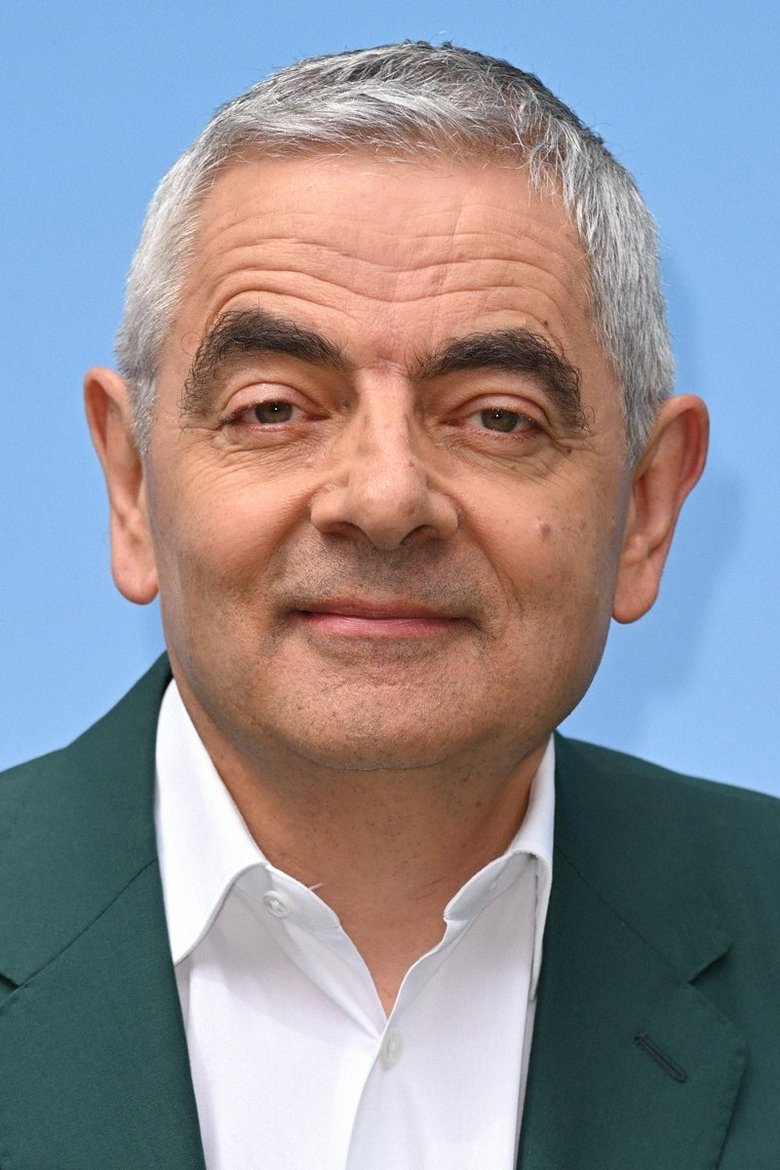
Rowan Atkinson
Rowan Sebastian Atkinson CBE (born 6 January 1955), is an English comedian, screenwriter, and actor. He is most famous for his work on the satirical sketch comedy show Not The Nine O'Clock News, and the sitcoms Blackadder, Mr. Bean, and The Thin Blue Line. He has been listed in The Observer as one of the 50 funniest actors in British comedy, and amongst the top 50 comedy actors ever in a 2005 poll of fellow comedians. Atkinson was born in Consett, County Durham, England. The youngest of four brothers, his parents were Eric Atkinson, a farmer and company director, and Ella May (née Bainbridge), who married on 29 June 1945. His three older brothers are Paul, who died as an infant; Rodney, a Eurosceptic economist who narrowly lost the UK Independence Party leadership election in 2000 and Rupert.
Main movies and TV shows
- The Lion King (1994) — Zazu (voice)
- Love Actually (2003) — Rufus, Jewellery Salesman
- Scooby-Doo (2002) — Mondavarious
- Wonka (2023) — Father Julius
- Johnny English (2003) — Johnny English
- Johnny English Reborn (2011) — Johnny English
- Mr. Bean's Holiday (2007) — Mr. Bean
- Four Weddings and a Funeral (1994) — Father Gerald
- Johnny English Strikes Again (2018) — Johnny English
- Bean (1997) — Mr. Bean
- Hot Shots! Part Deux (1993) — Dexter Hayman
- Rat Race (2001) — Enrico Pollini
- Never Say Never Again (1983) — Nigel Small-Fawcett
- Mr. Bean (1990) — Mr. Bean
- The Witches (1990) — Mr Stringer
- Man vs Bee (2022) — Trevor Bingley
- Keeping Mum (2005) — Walter Goodfellow
- Blackadder (1983) — Edmund, Duke of Edinburgh
- Mr. Bean: The Animated Series (2002) — Mr. Bean (voice)
- Red Nose Day Actually (2017) — Rufus
Facts
- Born: January 6, 1955 (age 71)
- Place of birth: Consett, United Kingdom
- Nationality: United Kingdom
- Birth name: Rowan Sebastian Atkinson
- Occupations: Actor, Comedian, Voice actor, Screenwriter
- Languages: English
- Education: Newcastle University, The Queen's College, Chorister School, St. Bees School
Family
- Spouse: Sunetra Sastry
- Partner: Leslie Ash, Louise Ford
- Father: Eric Atkinson
- Mother: Ella May Bainbridge
- Siblings: Rodney Atkinson
Detailed biography
Early life
Atkinson was born in Consett, County Durham, or Gosforth, Newcastle upon Tyne, Northumberland, England, on 6 January 1955. The youngest of four boys, his parents were Eric Atkinson, a farmer and company director, and Ella May (née Bainbridge), who married on 29 June 1945. His three older brothers are Paul, who died as an infant; Rodney, a Eurosceptic economist who narrowly lost the UK Independence Party leadership election in 2000; and Rupert.
Atkinson was brought up Anglican. He was educated at the Durham Chorister School, a preparatory school, and then at St Bees School. Rodney, Rowan and their older brother Rupert were brought up in Consett and went to school with the future Prime Minister, Tony Blair, at Durham Choristers. After receiving top grades in science A levels, he secured a place at Newcastle University, where he received a BSc degree in Electrical and Electronic Engineering in 1975. Atkinson briefly embarked on a PhD study at The Queen's College, Oxford, where his father had studied in 1935, before devoting his full attention to acting. He graduated with an MSc degree in Electrical Engineering and was made an Honorary Fellow of the college in 2006. His master's thesis, published in 1978, considered the application of self-tuning control.
Atkinson first won national attention in The Oxford Revue at the Edinburgh Festival Fringe in August 1976. He had already written and performed sketches for shows in Oxford by the Etceteras – the revue group of the Experimental Theatre Club (ETC) – and for the Oxford University Dramatic Society (OUDS), meeting writer Richard Curtis, and composer Howard Goodall, with whom he would continue to collaborate during his career.
Radio
Atkinson starred in a series of comedy shows for BBC Radio 3 in 1979 called The Atkinson People. It consisted of a series of satirical interviews with fictional great men, who were played by Atkinson himself. The series was written by Atkinson and Richard Curtis, and produced by Griff Rhys Jones.
Comic style
Best known for his use of physical comedy in his Mr. Bean persona, Atkinson's other characters rely more on language. Atkinson often plays authority figures (especially priests or vicars) speaking absurd lines with a completely deadpan delivery. Journalist Anwar Brett writes, "Although his deadpan wit is in evidence as he speaks, Atkinson – beloved to Blackadder as much as Bean fans – takes his comedy very seriously." On his ability to keep his focus on set during comedic moments, Johnny English director Oliver Parker commented, "There's a scene where Johnny English is in a meeting going up and down on an office chair. Rowan's focus is astonishing in that scene, because everybody else – he hadn't realised – was having to hold back, and when I said 'cut!' there was an explosion of laughter".
Atkinson has a stammer, and has commented that it does not occur as often when he is playing roles versus himself. His visually based style, as opposed to his more verbal style, has been compared to Buster Keaton.
Influences
Atkinson's early comedy influences were the sketch comedy troupe Beyond the Fringe, made up of Peter Cook, Dudley Moore, Jonathan Miller and Alan Bennett, major figures of the 1960s British satire boom, and then Monty Python. Atkinson states, "I remember watching them avidly as students at university". He continued to be influenced by the work of John Cleese following his Monty Python days, regarding Cleese as being "a major, major inspiration", adding, "I think that he and I are quite different in our style and our approach, but certainly it was comedy I liked to watch. He was very physical. Yes, very physical and very angry". He was also influenced by Peter Sellers, whose characters Hrundi Bakshi from The Party (1968) and Inspector Clouseau from The Pink Panther films influenced Atkinson's characters Mr. Bean and Johnny English.
Of Barry Humphries' Dame Edna Everage, he states, "I loved that character – again, it's the veneer of respectability disguising suburban prejudice of a really quite vicious and dismissive nature". Of visual comedians, Atkinson regards Charlie Chaplin, Buster Keaton and Harold Lloyd as influential. He was also inspired by French comedian Jacques Tati, stating, "Mr. Hulot's Holiday I remember seeing when I was 17 – that was a major inspiration. He opened a window to a world that I'd never looked out on before, and I thought, "God, that's interesting," how a comic situation can be developed as purely visual and yet it's not under-cranked, it's not speeded-up, it's more deliberate; it takes its time. And I enjoyed that".
Honours
Atkinson was appointed Commander of the Order of the British Empire in the 2013 Birthday Honours for his contribution to drama and charity.
Marriage and children
Atkinson met makeup artist Sunetra Sastry in the late 1980s when she was working for the BBC, and they married in February 1990. They had two children together, and lived in Apethorpe. His son Ben was an army officer in the Brigade of Gurkhas. In 2013, at the age of 58, Atkinson began a relationship with 32-year-old comedian Louise Ford after they met while performing in a play together. Ford ended her relationship with comedian James Acaster in order to be with Atkinson, who in turn separated from his wife in 2014 and divorced her in 2015. He has one child with Ford.
Cars
Atkinson holds a category C+E (formerly "Class 1") lorry driving licence, gained in 1981, because lorries held a fascination for him, and to ensure employment as a young actor. He has also used this skill when filming comedy material. In 1991, he starred in the self-penned The Driven Man, a series of sketches featuring Atkinson driving around London trying to solve his obsession with cars, and discussing it with taxi drivers, policemen, used-car salesmen and psychotherapists. A lover of and participant in car racing, he appeared as racing driver Henry Birkin in the television play Full Throttle in 1995.
From 1997 to 2015, Atkinson owned a rare McLaren F1, which was involved in an accident in Cabus, near Garstang, Lancashire, with an Austin Metro in October 1999. It was damaged again in a serious crash in August 2011 when it caught fire after Atkinson reportedly lost control and hit a tree. That accident caused significant damage to the vehicle, taking over a year to be repaired and leading to the largest insurance payout in Britain, at £910,000. He has previously owned a Honda NSX, an Audi A8, a Škoda Superb, and a Honda Civic Hybrid.
The Conservative Party politician Alan Clark, a devotee of classic motor cars, recorded in his published Diaries a chance meeting with a man he later realised was Atkinson while driving through Oxfordshire in May 1984: "Just after leaving the motorway at Thame I noticed a dark red DBS V8 Aston Martin on the slip road with the bonnet up, a man unhappily bending over it. I told Jane to pull in and walked back. A DV8 in trouble is always good for a gloat." Clark writes that he gave Atkinson a lift in his Rolls-Royce to the nearest telephone box, but was disappointed in his bland reaction to being recognised, noting that "he didn't sparkle, was rather disappointing and chétif".
In July 2001, Atkinson crashed an Aston Martin V8 Zagato at an enthusiasts' meeting, but walked away unhurt. This was while he was competing in the Aston Martin Owners Club event, at the Croft Racing Circuit, Darlington.
One car Atkinson has said he will not own is a Porsche: "I have a problem with Porsches. They're wonderful cars, but I know I could never live with one. Somehow, the typical Porsche people – and I wish them no ill – are not, I feel, my kind of people."
In July 2011, Atkinson appeared as the "Star in a Reasonably Priced Car" on Top Gear, driving the Kia Cee'd around the track in 1:42.2, which at the time granted him first place on the leaderboard; subsequently, only Matt LeBlanc set a faster time.
A February 2024 report by the House of Lords partly blamed Atkinson for poor sales of electric cars in the UK by "damaging" the public's perception of the vehicles. The report criticised a June 2023 opinion piece by Atkinson in The Guardian, who as an early adopter of electric vehicles, described EVs as "fast, quiet and, until recently, very cheap to run", but burdened by battery issues and misleading beliefs on their impact on the environment.
Plane incident
In March 2001, while Atkinson was on holiday in Kenya, the pilot of his private Cessna fainted; Atkinson managed to maintain the plane's flight and aid the pilot awake, after which the pilot was able to land the plane at Wilson Airport in Nairobi.
Political views
In June 2005, Atkinson led a coalition of the United Kingdom's most prominent actors and writers, including Nicholas Hytner, Stephen Fry, and Ian McEwan, to the British Parliament in an attempt to force a review of the Racial and Religious Hatred Bill, which they felt would give overwhelming power to religious groups to impose censorship on the arts.
In 2009, he criticised homophobic speech legislation, saying that the House of Lords must vote against a government attempt to remove a free-speech clause in an anti–gay hate law. Atkinson opposed the Serious Organised Crime and Police Act 2005 to outlaw inciting religious hatred, arguing that, "freedom to criticise ideas – any ideas even if they are sincerely held beliefs – is one of the fundamental freedoms of society. And the law which attempts to say you can criticise or ridicule ideas as long as they are not religious ideas is a very peculiar law indeed."
In October 2012, he voiced his support for the Reform Section 5 campaign, which aims to reform or repeal Section 5 of the Public Order Act 1986, particularly its statement that an insult can be grounds for arrest and punishment. It is a reaction to several recent high-profile arrests, which Atkinson sees as a restriction of freedom of expression. In February 2014, Parliament passed a redaction of the statute which removed the word "insulting" following pressure from citizens.
In 2018, Atkinson defended comments made by Boris Johnson over wearing the burqa, which were criticised as Islamophobic, and for which Johnson later apologised. Atkinson wrote to The Times stating, "as a lifelong beneficiary of the freedom to make jokes about religion, I do think that Boris Johnson's joke about wearers of the burka resembling letterboxes is a pretty good one." Atkinson's remarks were condemned by some former colleagues and fans.
In August 2020, Atkinson added his signature to a letter coordinated by Humanist Society Scotland along with twenty other public figures including novelist Val McDermid, playwright Alan Bissett, and activist Peter Tatchell, which expressed concern about the Scottish National Party's proposed Hate Crime and Public Order Bills. The letter argued the bill would "risk stifling freedom of expression".
In January 2021, Atkinson criticised the rise of cancel culture. He said, "It's important that we're exposed to a wide spectrum of opinion, but what we have now is the digital equivalent of the medieval mob, roaming the streets looking for someone to burn. The problem we have online is that an algorithm decides what we want to see, which ends up creating a simplistic, binary view of society. It becomes a case of either you're with us or against us. And if you're against us, you deserve to be 'cancelled'."
Source: Wikipedia — Text licensed under CC BY-SA 4.0