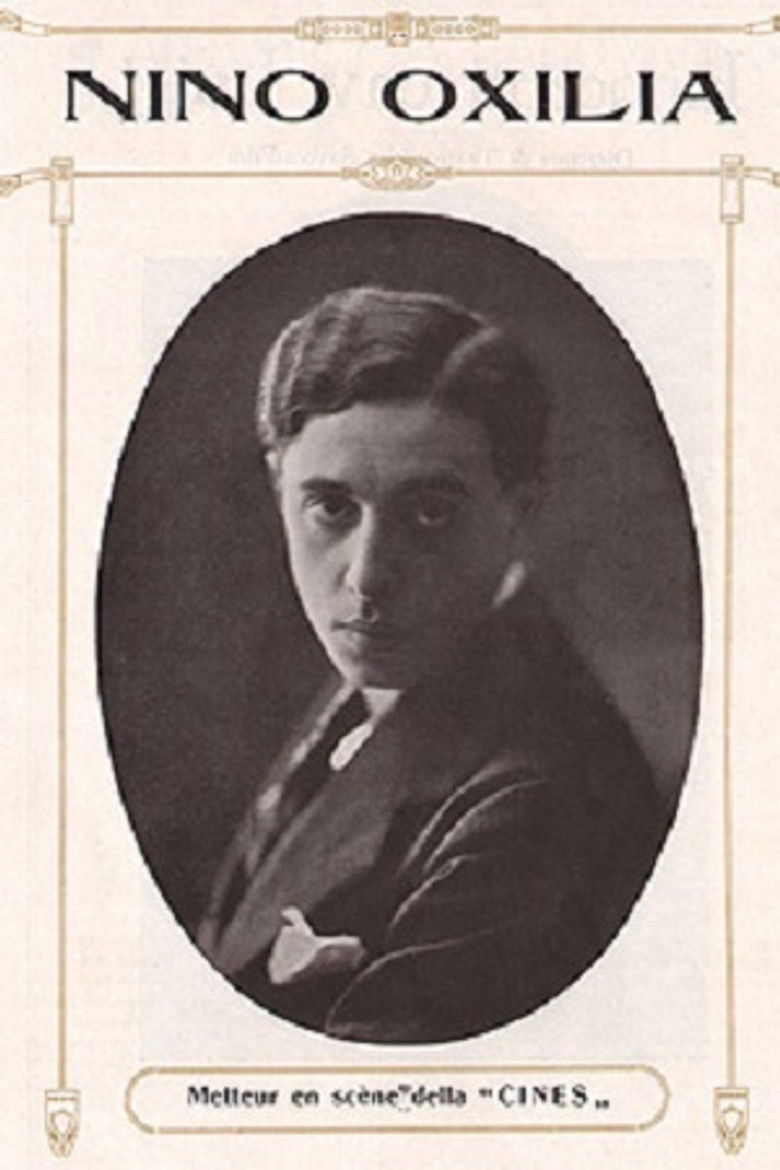
Nino Oxilia
Nino Oxilia (1889–1917) was an Italian playwright, screenwriter and film director.
Main movies and TV shows
- Satan's Rhapsody (1917) — Director
- Jenny (1915) — Director
- Blue Blood (1914) — Director
- Flower of Evil (1915) — Writer
- By the Cross (1913) — Director
- Papà (1915) — Director
- The Domestic Hearth (1914) — Director
- Addio giovinezza (1965) — Writer
Facts
- Born: November 13, 1889
- Place of birth: Turin, Italy
- Died: November 18, 1917, Mount Grappa, Italy, aged 28
- Nationality: Kingdom of Italy
- Occupations: Director, Writer, Journalist, Screenwriter
- Languages: Italian
Detailed biography
Early life and education
Nino Oxilia was born in Turin on 13 November 1889 to Nicolò and Giovanna. He was the fourth of five siblings. His older brother, Andrea Felice Oxilia, was a poet who translated Greek lyric poetry, while his sister, Anna, was the wife of the painter Cesare Maggi.
Oxilia attended the Liceo classico Cavour in Turin, where his professors included the noted classicist Vincenzo Ussani. After graduating from high school, he enrolled at the University of Turin, where he studied Law for two years without graduating. While there, he attended Arturo Graf's lectures on literary history. In 1907, he joined the editorial staff of the newspaper Gazzetta di Torino.
Early literary career
During this period, Oxilia became friends with several leading Turinese intellectuals, including Salvator Gotta, Guido Gozzano and Amalia Guglielminetti. In 1908, Oxilia and his friend Sandro Camasio wrote the three-act comedy La Zingara. The play premiered at the Teatro Carignano in Turin on 12 November 1909 and went on to be performed in Genoa and Milan.
That same year, Oxilia published his debut poetry collection, Canti brevi. The collection comprised 61 untitled pieces in a style akin to that of contemporary Crepuscular poets such as Gozzano. In 1909, Oxilia composed the song Il Commiato (The farewell), which was set to music by Giuseppe Blanc, a fellow law student. Originally widespread among students at the University of Turin, the goliardic song celebrated the end of studies and the impending assumption of adult responsibilities, resulting in the fading of the sweetness of youth. The song became immensely popular among Italian soldiers during the First World War. With modified lyrics, it became known as the Inno degli Arditi (Hymn of the Arditi, an elite special force of the Italian Royal Army). The hymn was further popularised by Gabriele D'Annunzio's mass rallies in Fiume, and was adopted by fascism under the title Giovinezza.
The following year, Oxilia, who had not abandoned his journalistic career, left the Gazzetta di Torino to join Il Momento, a progressive Catholic newspaper founded in 1903. The literary partnership between Oxilia and Camasio, reached its zenith with the three-act comedy Addio giovinezza! (Goodbye Youth), which premiered on 27 March 1911 at the Teatro Manzoni in Milan.
The protagonist, penniless Mario, who has come from the provinces to study law and is close to graduation, finds himself torn between his love for the candid milliner Dorina and his attraction to the mysterious Elena. Imbued with nostalgia for lost youth, the comedy was an immense success. First published in 1914 with a preface by Salvator Gotta, it was adapted for the screen several times in the following years.
World War I and death
At the outbreak of World War I, Oxilia volunteered and was appointed Second Lieutenant in the 3rd Artillery Regiment. Called up by the Special Propaganda Office of the Ministry of the Navy, he collaborated with the film department to produce two documentaries between late 1916 and 1917: Dall’Adriatico all’Egeo. Sbarco delle forze italiane in Albania and Dalla ritirata d’Albania alle trincee di Macedonia. In 1917, during a period of leave, he directed the film L’uomo in Frak, starring Berta Nelson and Augusto Poggioli.
Oxilia died on 18 November when the battery he was leading was hit by an Austrian shell on the slopes of Mount Tomba. His body was never recovered.
Legacy
In 2006, the French-German TV channel Arte restored Oxilia's masterpiece, Rapsodia Satanica and Staatsphilharmonie Rheinland-Pfalz, conducted by Frank Strobel recorded Mascagni's score.
In 2014, Amsterdam's Eye Filmmuseum restored Oxilia's 1914 film Blue Blood, starring the diva Francesca Bertini. The restored film was released on DVD by Cineteca Bologna in collaboration with Eye. The DVD also features a documentary by Giovanni Lasi about Oxilia's life and work.
Bibliography
Brunetta, Gian Piero (1991). Cent'anni di cinema italiano. Roma-Bari: Laterza. ISBN 978-8842038511.
Moliterno, Gino (2009). The A to Z of Italian Cinema. Lanham, Maryland: Scarecrow Press. ISBN 978-0810870598.
Source: Wikipedia — Text licensed under CC BY-SA 4.0