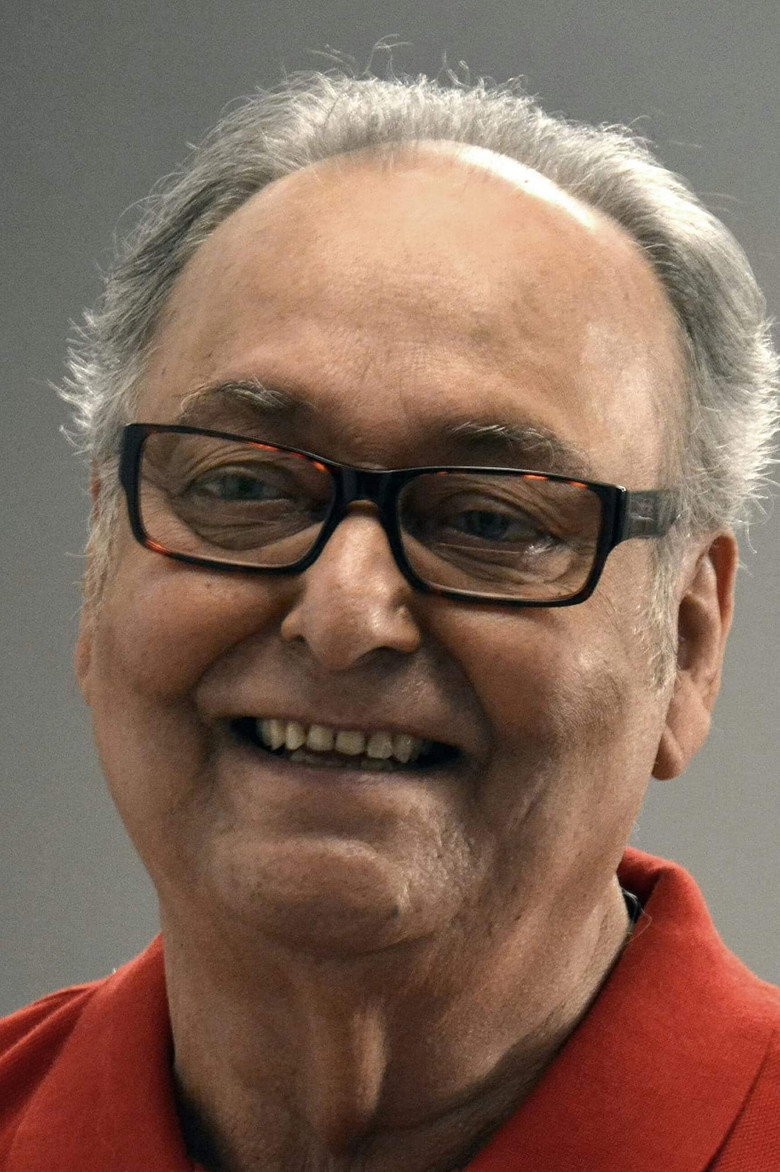
Soumitra Chatterjee
From Wikipedia, the free encyclopedia. Soumitra Chatterjee or Soumitra Chattopadhyay (Shoumitro Chôttopaddhae; born 19 January 1935 — 15 November 2020) was an Indian Bengali film and stage actor and poet. He was best known for his collaborations with Oscar-winning film director Satyajit Ray, with whom he worked in fourteen films, and his constant comparison with the Bengali cinema screen idol Uttam Kumar, his contemporary leading man of the 1960s and 1970s. Soumitra Chatterjee is also the first Indian film personality to be conferred with the Commandeur de l’ Ordre des Arts et des Lettres, France's highest award for artists. He is also the winner of the Dadasaheb Phalke Award which is India's highest award for cinema. Not only that, in 2017 exactly thirty years after auteur Satyajit Ray was honoured with France's highest civilian award, the coveted Legion of Honor, thespian Soumitra Chatterjee, arguably, the most prominent face of Ray's films, is set to receive the prestigious award. Starting with his debut film, Apur Sansar (The World of Apu, 1959), the third part of Apu Trilogy, he went on to work in several notable films with Ray, including Abhijan (The Expedition, 1962), Charulata (The Lonely Wife, 1964), Aranyer Din Ratri (Days and Nights in the Forest, 1969); Ashani Sanket (Distant Thunder, 1973); Sonar Kella (The Fortress, 1974) as Feluda and Joi Baba Felunath (The Elephant God, 1978) as Feluda, Ghare Baire (The Home and The World, 1984) and Ganashatru (Enemy of the People, 1989). Meanwhile, he also worked with other noted directors of Bengali cinema, with Mrinal Sen in Akash Kusum (Up in the Clouds, 1965), Tapan Sinha in Kshudhita Pashan (Hungry Stones, 1960), Jhinder Bandi (1961), Asit Sen in Swaralipi (1961), Ajoy Kar in Saat Pake Bandha (1963), Parineeta (1969), and Tarun Mazumdar in Sansar Simante (1975) and Ganadevata (1978). He acted more than 210 films in his career till 2016. He was awarded the Padma Bhushan by the Government of India in 2004. In 2012, he received the Dadasaheb Phalke Award, India's highest award in cinema given by the government of India for lifetime achievement. He has won two National Film Awards as an actor, and as an actor in Bengali theatre, he received the Sangeet Natak Akademi Award in 1998, given by the Sangeet Natak Akademi, India's National Academy of Music, Dance and Drama. In 2013, IBN LIVE named him as one of "The men who changed the face of the Indian Cinema". In 2014, he received the introductory Filmfare Awards East for Best Male Actor (Critics) for his role in Rupkatha Noy. Description above from the Wikipedia article Soumitra Chatterjee, licensed under CC-BY-SA, full list of contributors on Wikipedia.
Main movies and TV shows
- The World of Apu (1959) — Apurba 'Apu' Roy
- Charulata (1964) — Amal
- Devi (1960) — Umaprasad
- The Coward (1965) — Amitabha Roy
- The Elephant God (1979) — Prodosh Mitra (Feluda)
- Days and Nights in the Forest (1970) — Asim
- Distant Thunder (1973) — Gangacharan Chakravarti
- The Golden Fortress (1974) — Prodosh Chandra Mitra (Feluda)
- The Kingdom of Diamonds (1980) — Udayan Pandit
- The Home and the World (1985) — Sandip Mukherjee
- An Enemy of the People (1990) — Dr. Ashok Gupta
- Ahalya (2015) — Goutam Sadhu
- Three Daughters (1961) — Amulya (segment "The Conclusion")
- Praktan (2016) — Train Passenger
- The Expedition (1962) — Narsingh
- Belaseshe (2015) — Biswanath Majumdar
- Hemlock Society (2012) — Col Samaresh Bagchi (Special appearance)
- Shadows of Time (2005) — Ravi (Old)
- The Branches of the Tree (1990) — Prashanto Majumdar
- Apur Panchali (2014) — (Archive Footage)
Facts
- Born: January 19, 1935
- Place of birth: Krishnanagar, India
- Died: November 15, 2020, Kolkata, India, aged 85
- Nationality: India, British Raj
- Occupations: Actor, Writer, Composer, Poet
- Languages: Bangla, English
- Education: University of Calcutta, City College, Howrah Zilla School
Detailed biography
Early life and background
Soumitra Chatterjee was born in Mirjapur Street (now Surya Sen Street) near Sealdah railway station, in Calcutta in 1935. The first ten years of his early life were spent in Krishnanagar in West Bengal where he studied in C.M.S. St. John's High School. The town under the influence of playwright Dwijendralal Ray, also from Krishnanagar, had a flourishing theatre culture, with numerous small theatre groups. His grandfather was the president of one such group while his father, though lawyer by profession and later a government worker, also worked as an amateur actor. Encouraged by the praise he received for his acting in school plays, gradually his interest in theatre grew with passing years. He was a very close friend of famous theatre personality, Mrityunjay Sil who is often regarded as a key influence on his career.
Soumitra and his family moved to Howrah where he studied at the Howrah Zilla School and Calcutta during his early years. Soumitra graduated from the City College, Kolkata with honours in Bengali literature, as a graduating student of the University of Calcutta. He lived for a few years in Calcutta in Satyajit Ray's old apartment at 3-lake temple road. He studied for his M.A. in Bengali from the University of Calcutta. While still a student, he learnt acting under noted actor-director of Bengali theatre Ahindra Choudhury. However a turning point came when in the final year of college he saw a play by Sisir Bhaduri, theatre director and the doyen of Bengali theatre. The play not only set a standard for acting for him, but also helped make up his mind to become an actor. He managed to meet Bhaduri, through his friend's mother, actress Shefalika Putul. Though, he met Bhaduri, towards the end of his career, when his theatre had closed, nevertheless over the next three years, till Bhaduri's death in 1959, Chatterjee made him a mentor, and learnt the craft of acting through their regular interactions. He even appeared in a small role in one of Bhaduri's productions.
Subsequently, he started his career working in All India Radio as an announcer, While he was there he started pursuing a career in films. He came in touch with Ray during the casting for Aparajito (1956), who was looking for new faces. Ray thought he had the right look, however found him, age 20, and just out of college, too old for the role of adolescent Apu. Ray remembered him and offered him the role of adult Apu two years later. Meanwhile, he was rejected in his screen test for Bengali film, Nilachale Mahaprabhu (1957) directed by Kartik Chattopadhyay.
Other works
Besides working with Ray, Soumitra excelled in collaborations with other well-known Bengali directors such as Mrinal Sen and Tapan Sinha. He earned critical acclaim for his role of an impostor in Mrinal Sen's Akash Kusum (1965). He was equally confident in playing the swashbuckling horse-riding villain in Tapan Sinha's Jhinder Bandi (1961) giving the legendary Uttam Kumar a tough challenge. In the romantic film Teen Bhubaner Pare (1969), he shared the screen with actress Tanuja, the film was noted for his "flamboyant" style of acting. Besides films, Chatterjee continued acting in Kolkata-based Bengali theatre, and also published over 12 poetry books.
Entering the 1980s and 1990s, he started working with contemporary directors, like Goutam Ghose, Aparna Sen, Anjan Das and Rituparno Ghosh, and even acted on television. In 1986, he played the role of a swimming coach, Khitish Singh(Khidda) in film Kony (1986) directed by Saroj Dey, who was part of the film collective Agragami. The film is about a young girl from a slum, who wants to become a swimmer. At the 32nd National Film Awards, the film won the National Film Award for Best Popular Film Providing Wholesome Entertainment. Later in a 2012 interview, he called Kony one of the best films of his career. He even recalled using film's catch-phrase "Fight-Koni-fight" in hard times, as a chant to himself to lift his "aging spirits". The phrase had become popular with middle-class Bengalis at the time. He also starred in his biopic Abhijaan directed by Parambrata Chatterjee, an artist himself. The movie was released in April 2022 posthumously as a tribute to Soumitra featuring Jisshu Sengupta who portrayed the younger self of the late artist.
Illness and death
On 5 October 2020, Chatterjee tested positive for COVID-19 and was admitted on 6 October in Belle Vue Clinic, Kolkata. However, he tested negative to the second COVID-19 test conducted on 14 October. In the meantime, his complications (urinary tract infection, fluctuations in sodium potassium levels, etc.) made the condition critical and he had to be admitted to ICU. From 13 October, his condition started to improve marginally and on 14 October, he was transferred from a Covid unit to a non-Covid unit. He was kept on BiPAP support and invasive ventilation for in the critical times; after his improvement in health, the treatment mechanisms were changed. He was under the supervision of a medical team of 16 physicians. On 25 October, his condition further deteriorated. On 15 November 2020, Chatterjee died due to COVID-19 induced encephalopathy at Bellevue hospital in Kolkata at 12.15 p.m.
Bibliography
Robinson, Andrew (1989). Satyajit Ray: The Inner Eye. University of California Press. p. 362. ISBN 978-0-520-06946-6.
Ray, Satyajit (1996). My Years with Apu. Penguin Books India. ISBN 978-0-14-024780-0.
Ray, Satyajit (2007). Satyajit Ray: Interviews. Univ. Press of Mississippi. ISBN 978-1-57806-937-8.
Chattopadhyay, Soumitra (2026). Our Nataraj: Sisir Bhaduri – Theatre to Talkies. Comp., ed. and tr. by Mou Chakraborty. Sister Nivedita University Press. ISBN 978-81-997456-9-8.
Source: Wikipedia — Text licensed under CC BY-SA 4.0