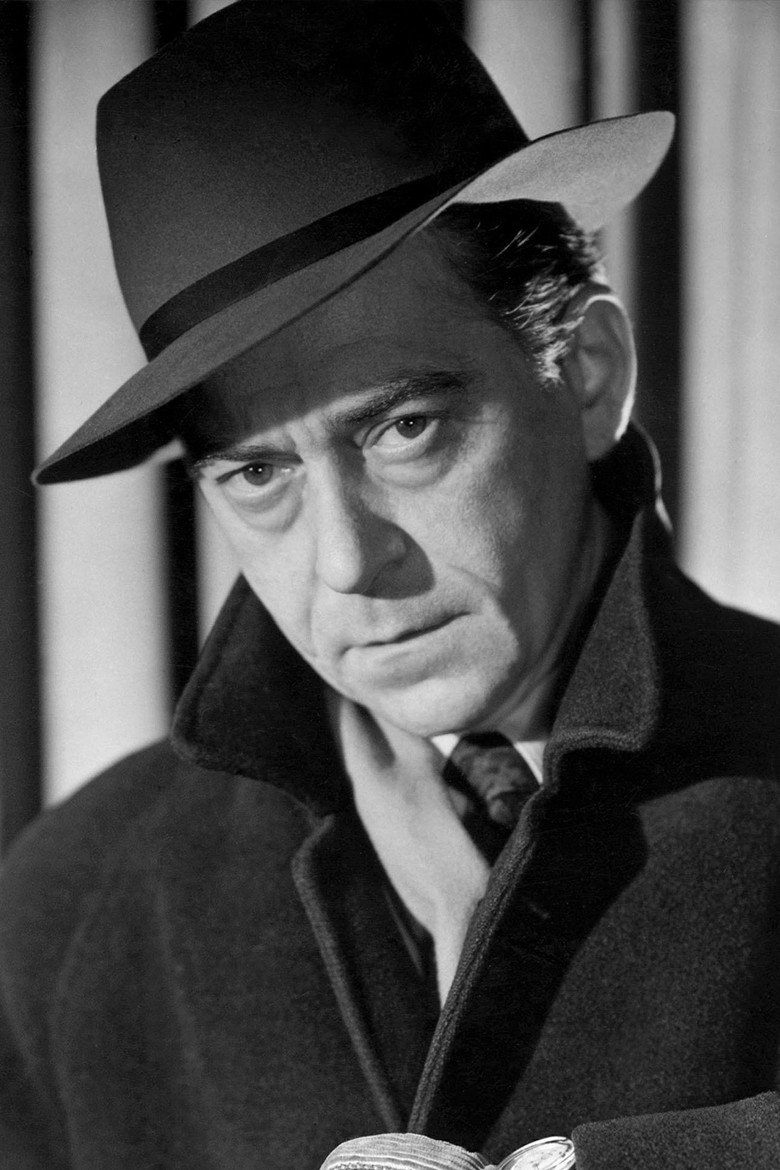
Jean Servais
Jean Servais was a Belgian actor best known for the French heist movie 'Rififi' and Luis Bunuel's 'Fever Mounts at El Pao'.
Main movies and TV shows
- The Longest Day (1962) — RAdm. Janjard
- Rififi (1955) — Tony le Stéphanois
- Donkey Skin (1970) — Narrator (voice)
- That Man from Rio (1964) — Prof. Norbert Catalan
- Le Plaisir (1952) — l'ami de Jean
- Lost Command (1966) — Gen. Melies
- Les Misérables (1934) — Marius Pontmercy
- The Devil's Nightmare (1971) — Baron von Rhoneberg
- Harvest (1937) — Albin
- Such a Pretty Little Beach (1949) — Fred
- Angele (1934) — Albin
- Fever Mounts at El Pao (1959) — Alejandro Gual
- Coplan Saves His Skin (1968) — Saroghu
- They Came to Rob Las Vegas (1968) — Gino
- He Who Must Die (1957) — Priest Fotis
- To Skin a Spy (1966) — Weigelt
- Thomas the Impostor (1965) — Pesquel-Duport
- The Glass Castle (1950) — Laurent Bartel
- The Game of Truth (1961) — Jean-François Vérate
- Crime Does Not Pay (1962) — Vaughan
Facts
- Born: September 24, 1912
- Place of birth: Antwerp, Belgium
- Died: February 17, 1976, 13th arrondissement of Paris, France, aged 63
- Nationality: Belgium, France
- Birth name: Jean Aimé Antoine Servais
- Occupations: Actor
- Languages: French
Family
- Spouse: Dominique Blanchar
- Partner: María Casares
Detailed biography
Career
Servais trained at the Brussels Conservatory of Dramatic Arts, where he won the Second Prize. His acting skills came to the attention of Raymond Rouleau, and he was hired at the Théâtre du Marais, where he acted in Le mal de jeunesse, which was successful in Brussels and in Paris. He was also a member of Jean-Louis Barrault's theatre company.
His first film role was as the simple country dweller who was the victim of an error by the justice system in the film Criminel (1932), directed by Jack Forrester. Servais's film career continued in the 1930s with roles in films such as La Chanson De L'Adieu (1934) and La Vie Est Magnifique (1938). After a break in acting during World War II, he returned to the screen with roles in films such as La Danse De Mort (1948).
In the 1950s, he appeared in the crime drama Rififi (1955), which François Truffaut ranked as the best film noir, directed by American Jules Dassin, in which he played a leader of a gang of jewel thieves.
He appeared in another film directed by Jules Dassin in 1957, He Who Must Die (Celui qui doit mourir). He also appeared in a film written and directed by Luis Buñuel, La fièvre monte à El Pao (1959).
In the 1950s and 1960s, Servais rejoined the Renaud-Barrault theatre troupe for several plays, including La Répétition ou l'Amour puni (1950), Volpone (1955), and Marat/Sade (1966).
In the 1960s, Servais took small character roles in popular international fare such as The Longest Day (1962), an epic recreation of the Allied invasion of Normandy, and That Man from Rio (1964). Other films in which he acted include Le Sahara brûle (1961), Un Soir Par Hasard (1964), and Avec la peau des autres (1966).
He had roles in several films in the early 1970s, such as The Devil's Nightmare (1971), an Italian horror series, and Le Protecteur (1974), about a recently released prisoner who tries to find his daughter who has fallen into the underworld of prostitution.
Source: Wikipedia — Text licensed under CC BY-SA 4.0