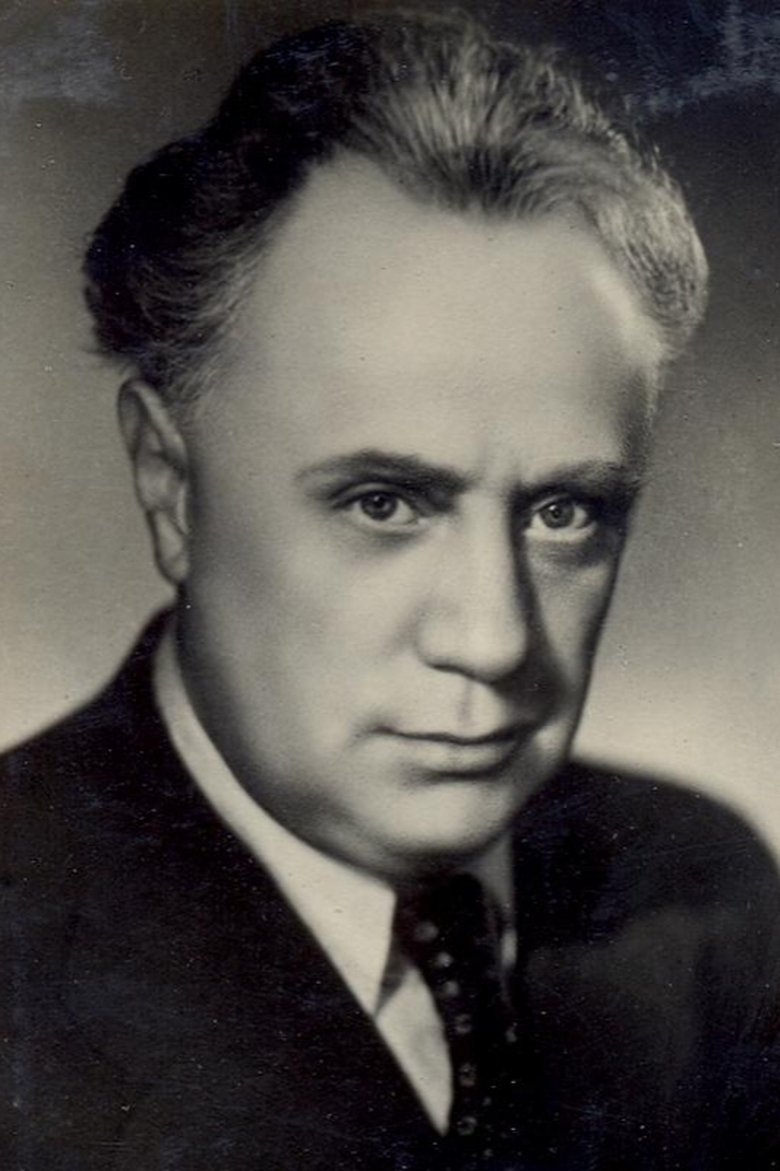
Mikhail Zharov
Mikhail Ivanovich Zharov is a Soviet theater and film actor. People's Artist of the RSFSR (1944) and People's Artist of the USSR (October 26, 1949). In 1920, he graduated from the studio at the theater of the Artistic and Educational Union of Workers' Organization. He acted in theaters No. 1 of the Revolutionary Military Union of the Republic, the Safonov Theater, the Baku Workers' Theater, the Realistic Theater, and the Moscow Chamber Theater. From 1938, he was an actor and director at the Maly Theater. He made his film debut in 1915 with a tiny, practically unnoticeable role as an oprichnik in the film "Tsar Ivan Vasilyevich the Terrible." He played his first major role, that of Red Army soldier Yegor, in 1925 in the film "The Road to Happiness." In those years, Zharov was considered an unrivaled master of the episodic genre (Don Diego and Pelageya, The Man from the Restaurant, The White Eagle, The Living Corpse, Outskirts, and Puppets). He found expressive, distinctive details and rich, vibrant colors for his characters, imbuing them all—both villains and heroes—with a common quality: they are all great lovers of life, charming, confident, and in control of life. His heroes know how to enjoy everything: food, billiards, wine, women, the simple songs they often hum, a sunny day, or an unexpected win. Zharov combined absolute authenticity and vivid psychological characterization with a sometimes grotesque portrayal of the role, enlivening any plot, even the most serious, with his presence. In the 1930s, thanks to cinema, Zharov achieved national popularity. The artist was in great demand. He was invited by the most famous directors. With Nikolai Ekk he played one of his most famous roles - the bandit Zhigan (A Start in Life), with Grigory Kozintsev and Leonid Trauberg - the smug clerk Dymba (The Return of Maxim and The Vyborg Side), with Vladimir Petrov - the cheerful prankster Kudryash (The Storm) and the good-natured, cheerful courtier Menshikov (Peter the Great), with Isidor Annensky - the loud, healthy landowner Smirnov (The Bear), the cheerful teacher Kovalenko (The Man in the Case) and the carefree landowner Artynov (Anna on the Neck), with the Vasiliev brothers - the daring Cossack Perchikhin (The Defense of Tsaritsyn), with Sergei Eisenstein - Malyuta Skuratov, a cunning, cruel, "smart" peasant, who managed to become the Tsar's right hand ("Ivan the Terrible"). In 1944, he was awarded "For successful work in the field of Soviet cinematography during the Patriotic War and the release of highly artistic films." In total, M.I. Zharov starred in more than 60 films. Over the years, the courage of his characters diminished; they became calmer, wiser, and more grounded. His last film character was the rural policeman Aniskina ("The Village Detective," "Anikina and Fantomas," "And Again Aniskina"). The role was a signature one for the actor: his Aniskina is a village philosopher, a sage, insightful, unfussy, and attentive to all matters. A hero who affirms the belief that our lives depend on our own decision to live correctly and wisely. As a film director, Zharov made three films: “Troublesome Economy”, “Aniskine and Fantomas” (together with V.A. Rappoport), “And Again Aniskine” (together with V.I. Ivanov).
Main movies and TV shows
- Ivan the Terrible, Part I (1944) — Czar's Guard Malyuta Skuratov
- Ivan the Terrible, Part II: The Boyars' Plot (1958) — Czar's Guard Malyuta Skuratov
- Aelita: Queen of Mars (1924) — Actor in Play
- Chess Fever (1925) — House Painter
- Outskirts (1933) — Krayevitch, a student
- Road to Life (1931) — Фомка «Жиган»
- Miss Mend (1926) — Waiter at the inn
- Peter the First, Part I (1937) — Alexander Danilovich Menshikov
- Michurin (1949) — Khrenov
- The Vyborg Side (1939) — Platon Vassilievich Dymba
- The Living Corpse (1929) — Hired witness (uncredited)
- The Anna Cross (1954) — Artynov
- The Return of Maxim (1937) — Platon Dymba
- The Man from the Restaurant (1927) — Waiter
- The Cigarette Girl of Mosselprom (1924) — sluzhashchiy i nosil'shchik
- A Girl with Guitar (1958) — Sviristinsky
- A Noisy Household (1946) — Semibab
- Bohdan Khmelnytskyi (1941) — cantor Havrylo
- Peter the First, Part II (1938) — Alexander Danilovich Menshikov
- The Yellow Ticket (1928) — Visitor in the brothel
Facts
- Born: October 15, 1899
- Place of birth: Moscow, Russia
- Died: December 15, 1981, Moscow, Russia, aged 82
- Nationality: Russian Empire, Soviet Union
- Occupations: Actor, Director, Theatre director, Writer
- Languages: Russian
Family
- Spouse: Lyudmila Tselikovskaya
- Children: Anna Zharova
Detailed biography
Career
He studied under the prominent director Theodore Komisarjevsky and debuted in Yakov Protazanov's Aelita (1924). Later he became a Protazanov regular, appearing in The Man from the Restaurant (1927) together with Mikhail Chekhov.
In the 1930s he was a leading actor of Alexander Tairov's Chamber Theatre before moving to the Maly Theatre where, starting in 1938, he was engaged for the rest of his life and most fully unfolded his actor's gift, mainly playing classical repertoire parts (in Wolves and Sheep, The Inspector-General, Heart is not a Stone, The Thunderstorm, etc.)
Mikhail Zharov gained wide popularity thanks to the role of Zhigan in Nikolai Ekk’s internationally known drama Road to Life (1931). Playing the leader of a gang of thieves, the actor made use of the opportunities of the first sound film: he endowed his character with a specific accent, played the guitar, and sang songs with his peculiar charm. In 1933 he appeared in Boris Barnet's Outskirts.
The most acclaimed of his sound films were Vladimir Petrov's Peter the Great (1937), in which he played Prince Menshikov, and Sergei Eisenstein's Ivan the Terrible (1945/58), in which he played Malyuta Skuratov. His last and probably most popular role was that of Aniskin, an amusing and witty village militiaman in the television series The Village Detective (1968), Aniskin & Fantomas (1974) and Aniskin Again (1978).
Death
Mikhail Zharov died in Moscow on December 15, 1981, in his 83rd year, of peritonitis. He was buried at Novodevichy Cemetery (plot No. 9).
Source: Wikipedia — Text licensed under CC BY-SA 4.0