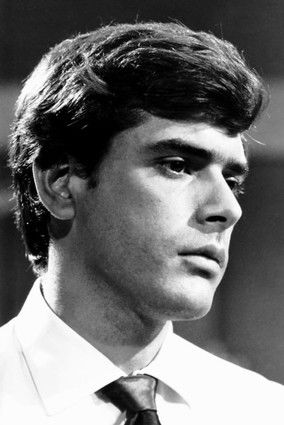
Tomas Milian
Tomás Milián (1933–2017) was a Cuban-American actor best known for having worked extensively in Italian films from the late 1950s to the 1980s.
Main movies and TV shows
- Traffic (2000) — Gen. Arturo Salazar
- JFK (1991) — Leopoldo
- Amistad (1997) — Calderon
- Oz (1997) — Ricardo Alvarez
- Law & Order (1990) — Colonel Emilio Pantoya
- Fools Rush In (1997) — Tomas
- The Yards (2000) — Manuel Sequiera
- Miami Vice (1984) — Octavio Arroyo
- Revenge (1990) — Cesar
- Murder, She Wrote (1984) — Enrico Montejano
- Don't Torture a Duckling (1972) — Andrea Martelli
- The Big Gundown (1967) — Manuel 'Cuchillo' Sanchez
- The Cowboy Way (1994) — Manny Huerta
- Havana (1990) — Menocal
- Boccaccio '70 (1962) — Conte Ottavio (segment "Il lavoro")
- The Agony and the Ecstasy (1965) — Raphael
- Thieves and Robbers (1983) — Tony Roma
- Ro.Go.Pa.G. (1963) — Centurione (segment "La ricotta") (uncredited)
- Luna (1979) — Giuseppe
- The Lost City (2005) — Don Federico Fellove
Facts
- Born: March 3, 1933
- Place of birth: Havana, Cuba
- Died: March 22, 2017, Miami, United States, aged 84
- Nationality: United States, Cuba, Italy
- Birth name: Tomás Quintín Rodríguez
- Occupations: Actor, Screenwriter, Voice actor
- Languages: Spanish, English, Italian
Detailed biography
Early life and education
Milián was born in the Cotorro municipality of Havana in 1933. His father, also named Tomás, was a General in the Machado regime. After the Revolt of the Sergeants and the start of the Fulgencio Batista's dictatorship, the elder Tomás was arrested, jailed, and later committed suicide on New Year's Eve 1946 in the presence of his son.
In 1955, after seeing the film East of Eden, Milián decided to leave Cuba and pursue his wishes of being an actor. He moved to the United States, enrolling in the University of Miami. After two years, he moved to New York City to study method acting at the Actors Studio, as a student of Lee Strasberg. Around that time, he became an American citizen.
Acting career
After starting a career in the United States, Milian went to Italy in 1958 to take part in a theatre festival in Spoleto. In Italy, he was discovered by director Mauro Bolognini and appeared in supporting roles in several drama films during the late 1950s and early 1960s.
He eventually decided to relocate to Italy, where he lived for over 25 years, becoming a very successful performer. His first film part in Italy was in the 1959 picture La notte brava. Although his voice was usually dubbed due to his accent, Milián performed his lines in Italian (or in English, depending on the film). He initially starred in arthouse movies and worked with directors such as Mauro Bolognini, Luchino Visconti, and Pier Paolo Pasolini.
After five years of making what he deemed "intellectual" movies, Milián was unhappy with his contract with producer Franco Cristaldi and thought of going back to the United States. Needing money to start over, he took the opportunity to star as a bandit in a Spaghetti Western called The Bounty Killer. The film boosted his career, and ultimately resulted in his staying in Italy. He became a star of the Spaghetti Western genre, where he often played Mexican bandits or revolutionaries, roles in which he spoke in his real voice. He starred in The Ugly Ones (1966), The Big Gundown (1966), Django Kill... If You Live, Shoot! (1967), Face to Face (1967), Run, Man, Run (1968), Death Sentence (1968), Tepepa (1969), Compañeros (1970), Sonny and Jed (1972), Life Is Tough, Eh Providence? (1972) and Four of the Apocalypse (1975).
In 1969, he became a naturalized Italian citizen.
As the Spaghetti Westerns dwindled, Milián remained a star in many genre films, playing both villains and heroes in various polizieschi movies. He starred with Barbara Bouchet in the giallo Don't Torture a Duckling. In addition to his role in Almost Human (1974) and appearances in Emergency Squad (1974), The Tough Ones (1976) and The Cynic, the Rat and the Fist (1977), he also appeared in two film series - Bruno Corbucci's Nico Giraldi series (1976-1984, beginning with The Cop in Blue Jeans) and Umberto Lenzi's Er Monnezza films (1976-1980, beginning with Free Hand for a Tough Cop). His other films during this period include the giallo Don't Torture a Duckling (1972) and the non-genre films The Last Movie (1971), Luna (1979), Identification of a Woman (1982) and Monsignor (1982).
He later turned to comedy, playing the recurrent characters of petty thief Monnezza and Serpico-like police officer Nico Giraldi in a variety of crime-comedy pictures. Although his voice was dubbed most of the time by Ferruccio Amendola, Milián wrote his own lines in Roman slang. Milián's inventive use of romanesco (Roman dialect) made him a cult performer in Italy. Bruno Corbucci, the director of many of these films commented, "At the cinemas as soon as Tomás Milián appeared on the screen, when he made a wisecrack and in the heaviest situations, then it was a pandemonium, it was like being at the stadium." As Milián used similar makeups and accents in portraying both characters, Monnezza and Nico were occasionally confused by Italian audiences, who sometimes referred erroneously to them both as Monnezza, or Er Monnezza (Da trash in Roman slang), and still closely associate Milián with these performances.
Milián also appeared in non-genre pictures, such as Bernardo Bertolucci's La Luna, for which he won a Nastro d'Argento for Best supporting Actor, and Michelangelo Antonioni's Identification of a Woman.
As he grew older, Milián decided to go back to the United States. He appeared in Sydney Pollack's Havana, Steven Spielberg's Amistad, Steven Soderbergh's Traffic as well as Andy García's The Lost City, about Revolutionary Cuba. He has also played many roles on stage. In 2005, he portrayed Generalisimo Rafael Leonidas Trujillo Molina in the film version of Mario Vargas Llosa's novel The Feast of the Goat.
Musical career
Milián, in addition to his acting career, was also an accomplished musician. In 1966, he founded the Tomas Milian Group with Ray Lovelock (vocals), Maurizio Luzi (guitar), Aldo "Fido" Colangelo (keyboard, vocals), Mario Piccinno (drums), Romeo Piccinno (guitar, vocals), and Peppe Colella (bass). He also wrote and performed the theme songs to several of his films.
Personal life
Milian was openly bisexual. In a 2014 interview, he stated the first person he came out to was Claudia Cardinale. He married actress Margherita "Rita" Valletti with whom he had a son, Tomaso.
Death
Milian was found dead from a stroke at his home in Miami on March 22, 2017.
On October 11, 2017, he received the Leone in Memoriam award at the 7º Almería Western Film Festival. It was picked up by his friend Luis Santeiro.
Source: Wikipedia — Text licensed under CC BY-SA 4.0