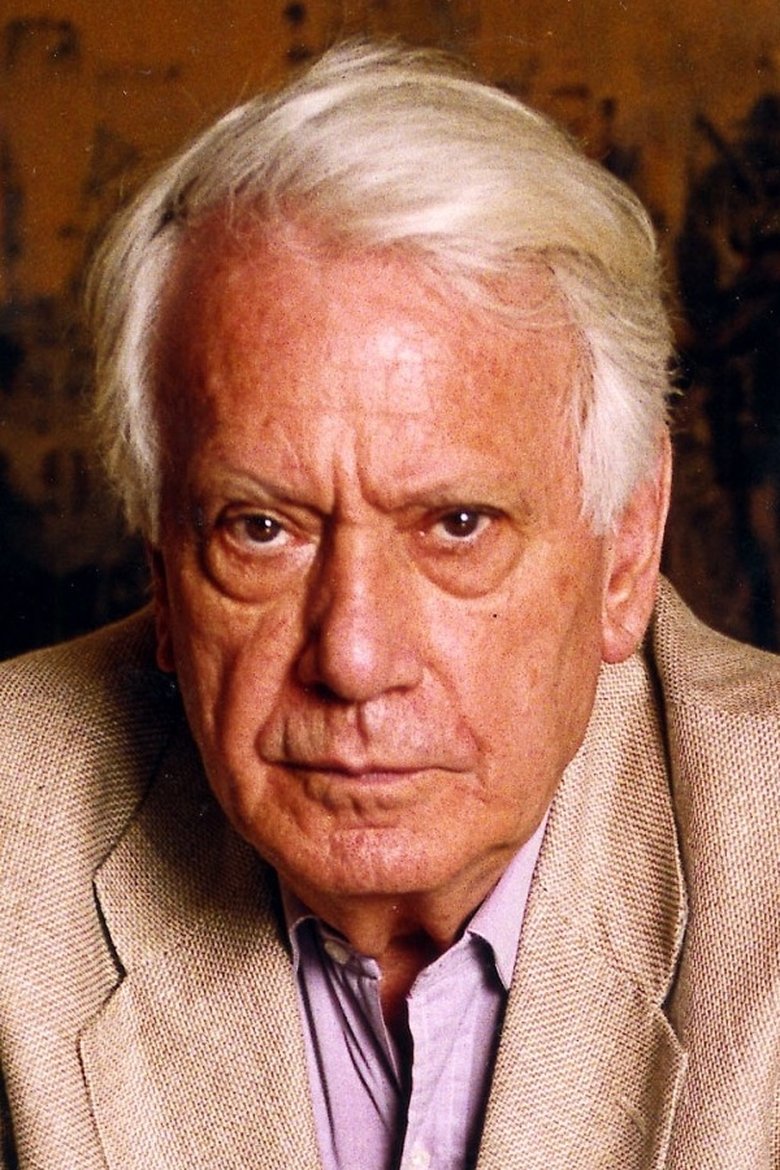
Jorge Semprún
Jorge Semprún Maura was a Spanish writer and politician. From 1953 to 1962, during the dictatorship of Francisco Franco, Semprún lived clandestinely in Spain working as an organizer for the exiled Communist Party of Spain, but was expelled from the party in 1964. After Franco's death and the change to a democratic government, he was Spain's Minister of Culture from 1988 to 1991. He was screenwriter for two successive films by Greek director Costa-Gavras. In 1996 he became the first non-French author to be elected a member of the Académie Goncourt, which awards an annual literary prize.
Main movies and TV shows
- Z (1969) — Writer
- The Confession (1970) — Writer
- Stavisky... (1974) — Writer
- K (1997) — Writer
- Special Section (1975) — Writer
- The War Is Over (1966) — Narrator (voice) (uncredited)
- A Woman at Her Window (1976) — Writer
- Objective: 500 Million (1966) — Writer
- Roads to the South (1978) — Writer
- L'Affaire Dreyfus (1995) — Writer
- Le Temps du silence (2011) — Writer
- The Sidewalks of Saturn (1986) — Writer
- Los desastres de la guerra (1983) — Creator, Writer
- Les Deux mémoires (1974) — Director, Writer
- Ah, c'était ça la vie! (2010) — Writer
Facts
- Born: December 10, 1923
- Place of birth: Madrid, Spain
- Died: June 7, 2011, 7th arrondissement of Paris, France, aged 87
- Nationality: Spain, France
- Birth name: Jorge Semprún Maura
- Occupations: Screenwriter, Writer, Politician, Philosopher
- Languages: Spanish, French
- Education: Lycée Henri-IV
Family
- Spouse: Colette Leloup, Loleh Bellon
- Children: Jaime Semprun
- Father: José María Semprún Gurrea
- Mother: Susana Maura Gamazo
- Siblings: Carlos Semprún
Detailed biography
Early life and education
Jorge Semprún Maura was born in 1923 in Madrid. His mother, who died when Jorge was eight, was Susana Maura Gamazo, the youngest daughter of Antonio Maura, who served several times as prime minister of Spain. His father, José María Semprún Gurrea (1893–1966), was a liberal politician and served as a diplomat for the Republic of Spain during the Spanish Civil War.
Émigrés and World War II
In the wake of the military uprising led by General Franco in July 1936, the Semprún family moved to France, and then to The Hague where his father was a diplomat, representing the Republic of Spain in the Netherlands. After the Netherlands officially recognized the Franco government in the beginning of 1939, the family returned to France as refugees. Jorge Semprún enrolled there at the Lycée Henri IV and later the Sorbonne.
During the Nazi occupation of France, the young Semprún joined the Francs-Tireurs et Partisans – Main-d'Œuvre Immigrée (FTP-MOI), a Resistance organization made up mostly of immigrants. After joining the Spanish Communist Party in 1942 in France, Semprún was reassigned to the Francs-Tireurs et Partisans (FTP), the Communist armed Resistance. In 1943 he was arrested by the Gestapo and deported to Buchenwald concentration camp for his role in the Resistance. He deals with the experiences in two books: Le grand voyage (1963) treats the journey to Buchenwald, and Quel beau dimanche! (1980) his camp experiences.
In 1945, Semprún returned to France and became an active member of the exiled Communist Party of Spain (PCE). From 1953 to 1962, he was an important organizer of the PCE's clandestine activities in Spain, using the pseudonym of Federico Sánchez. He entered the party's executive committee in 1956. In 1964, he was expelled from the party because of "differences regarding the party line", and from then on he concentrated on his writing career.
Semprún wrote many novels, plays, and screenplays, for which he received several nominations, including an Academy Award in 1970, and awards, including the 1997 Jerusalem Prize. He was a screenwriter for two successive films by the Greek director Costa-Gavras, dealing with the theme of persecution by governments, Z (1969) and The Confession (1970). For his work on Z, he was nominated for the Academy Award for Best Adapted Screenplay but did not win.
He was a member of the jury at the 1984 Cannes Film Festival. In 1988 he was appointed Minister of Culture in Felipe González's second government, despite being neither an elected MP nor a member of the Socialist Party (PSOE). He resigned the post three years later after publishing an article openly criticising the vice-president, Alfonso Guerra, and his brother Juan Guerra.
In 1996, Semprún became the first non-French author to be elected to the Académie Goncourt, which awards an annual prize for literature written in French. In 2002, he was awarded the inaugural Ovid Prize in recognition of his entire body of work, which focuses on "tolerance and freedom of expression".
Jorge Semprún served as the honorary chairman of the Spanish branch of Action Against Hunger. He lived in Paris. In 2001, while giving a conference at the Lycée Frédéric Mistral in Avignon, France, he inspired young Pablo Daniel Magee to become a writer. Magee went on to write Opération Condor, prefaced by Costa Gavras.
Style and themes
Semprún wrote primarily in French and alluded to French authors as much as to Spanish ones. Most of his books are fictionalized accounts of his deportation to Buchenwald. His writing is non-linear and achronological. The narrative setting shifts back and forth in time, exploring the past and future in relation to key events. With each recounting, events take on different meanings. Semprún's works are self-reflexive. His narrators explore how events live on in memory and means of communicating the events of the concentration camp to readers who cannot fathom that experience. His more recent work in this vein also includes reflections on the meaning of Europe and of being European, as informed by this period of history, including how Buchenwald was reopened by Soviet forces as Special Camp No. 2 of the NKVD, and then largely razed and planted over by East Germany to hide the mass graves from this second dark episode.
Semprún's writing in Spanish deals with Spanish subject matter, and includes two volumes of memoirs: Autobiografía de Federico Sánchez, about his clandestine work in and later exclusion from the Spanish Communist Party (1953–64), and Federico Sánchez se despide de ustedes, which deals with his term of service as Minister of Culture in the second Socialist government of Felipe González (1988–91). A novel in Spanish, Veinte años y un día, is set in 1956 and deals with recent history in Spain.
Marriage and family
Semprún married the actress Loleh Bellon in 1949. Their son, Jaime Semprún (1947–2010), was also a writer. Later Semprún married the French film editor Colette Leloup in 1958. They had five children, including Pablo Semprún. He is the brother of the writer Carlos Semprún (1926–2009).
Source: Wikipedia — Text licensed under CC BY-SA 4.0