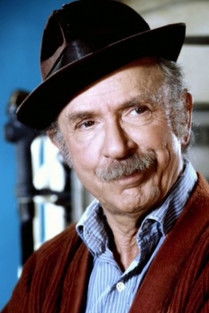
Jack Albertson
Jack Albertson (June 16, 1907 – November 25, 1981) was an American character actor dating to vaudeville. A comedian, dancer, singer, and musician, Albertson is perhaps best known for his roles as Manny Rosen in The Poseidon Adventure (1972), Grandpa Joe in the 1971 version of Willy Wonka and the Chocolate Factory, Amos Slade in the 1981 animated film "The Fox and the Hound" (1981), and as Ed Brown in the 1974-1978 television sitcom Chico and the Man. For contributions to the television industry, Jack Albertson was honored with a star on the Hollywood Walk of Fame at 6253 Hollywood Boulevard.
Main movies and TV shows
- The Sword in the Stone (1963) — Knight in Crowd #1 (uncredited)
- Willy Wonka & the Chocolate Factory (1971) — Grandpa Joe
- The Fox and the Hound (1981) — Amos Slade (voice)
- The Twilight Zone (1959) — Jerry Harlowe
- The Poseidon Adventure (1972) — Manny Rosen
- Miracle on 34th Street (1947) — Al (uncredited)
- Dead & Buried (1981) — William G. Dobbs
- I Love Lucy (1951) — Helicopter Dispatcher
- Charlie's Angels (1976) — Edward Jordan
- Days of Wine and Roses (1963) — Trayner
- The Andy Griffith Show (1960) — Bradford J. Taylor
- Lover Come Back (1961) — Fred
- The Harder They Fall (1956) — Pop
- How to Murder Your Wife (1965) — Dr. Bentley
- Gunsmoke (1955) — Danny Wilson
- Night Gallery (1970)
- The Dick Van Dyke Show (1961) — Mr. Eisenbauer
- Teacher's Pet (1958) — Guide
- The Streets of San Francisco (1972)
- The Shaggy Dog (1959) — Reporter (uncredited)
Facts
- Born: June 16, 1907
- Place of birth: Malden, United States
- Died: November 25, 1981, Hollywood, United States, aged 74
- Nationality: United States
- Height: 1.80 m
- Occupations: Actor, Comedian, Singer, Dancer
- Languages: English
Family
- Spouse: June Wallace Thomson
- Children: Maura Dhu Studi
- Siblings: Mabel Albertson
Detailed biography
Early life
Albertson was born on June 16, 1907, in Malden, Massachusetts, the son of Russian-Jewish immigrants Flora (née Craft) and Leopold Albertson. His older sister was actress Mabel Albertson. Their mother, a stock actress, supported the family by working in a shoe factory. Until the age of 22, Albertson was known as "Harold Albertson".
During a 1972 New York Daily News interview with Sidney Fields, Albertson reminisced: "I was bright but disruptive. I didn't do homework. To cover, I made wisecracks and funny faces at the teachers. They told me to take my business elsewhere."
When he was eighteen, he began to be paid for his prize winning shows. His sister Mabel taught him the first "time steps" in tap dancing, and he picked up additional routines by watching vaudeville acts that played his hometown. Around this time, he started singing with a group called "The Golden Rule Four," who held their practice sessions beneath a railroad bridge.
Broadway
Albertson joined the vaudeville road troupe known as the Dancing Verselle Sisters. He then worked in burlesque as a hoofer (soft shoe dancer) and straight man to Phil Silvers on the Minsky's Burlesque Circuit. Besides vaudeville and burlesque, he appeared on the stage in many Broadway plays and musicals, including High Button Shoes, Top Banana, The Cradle Will Rock, Make Mine Manhattan, Show Boat, Boy Meets Girl, Girl Crazy, Meet the People, The Sunshine Boys – for which he received a Tony Award nomination for Best Actor, and The Subject Was Roses – for which he won a Tony for Best Supporting Actor.
Radio
Albertson was a radio performer early in his career. Among the shows he appeared on were Just Plain Bill, Lefty, That's My Pop and The Jack Albertson Comedy Show. In the late 1940s he was for a time a regular on the Milton Berle Show.
Death
On the morning of November 25, 1981, Albertson died at his Los Angeles home in the Hollywood Hills at the age of 74 from colon cancer. He and his elder sister, Bewitched actress Mabel Albertson (who died 10 months later from Alzheimer's disease), were cremated and their ashes were scattered in the Pacific Ocean.
Personal life
He and his wife, Wallace, had one daughter, Maura Dhu, who is married to actor Wes Studi.
Source: Wikipedia — Text licensed under CC BY-SA 4.0