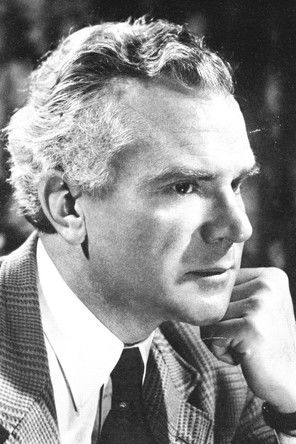
Esmond Knight
Esmond Penington Knight (4 May 1906 – 23 February 1987) was an English actor. He was an accomplished actor with a career spanning over half a century. For much of his career Esmond Knight was virtually blind. He had been badly injured in 1941 whilst on active service on board HMS Prince of Wales when she fought the Bismarck at the Battle of the Denmark Strait, and remained totally blind for two years, though he later regained some sight in his right eye. During this period, Esmond dictated an early autobiography to his secretary, Annabella Cloudsley, Seeking The Bubble (Hutchinson & Co. 1943). He played the captain of the HMS Prince of Wales in the 1960 movie Sink the Bismarck! He starred as Professor Ernest Reinhart in the 1961 British science fiction television series, A for Andromeda, alongside Patricia Kneale and Peter Halliday. His daughter is the actress Rosalind Knight. Knight died of a heart attack. He was cremated. Description above from the Wikipedia article Esmond Knight, licensed under CC-BY-SA, full list of contributors on Wikipedia.
Main movies and TV shows
- Superman IV: The Quest for Peace (1987) — Second Elder
- Peeping Tom (1960) — Arthur Baden
- The Red Shoes (1948) — Livy
- Doctor Who (1963) — Dom Issigri
- Black Narcissus (1947) — The Old General
- The Spy Who Came In from the Cold (1965) — Old Judge
- Hamlet (1948) — Bernardo
- Robin and Marian (1976) — Old Defender
- The Element of Crime (1984) — Osborne
- The Prince and the Showgirl (1957) — Hoffman
- I, Claudius (1976) — Domitius
- Anne of the Thousand Days (1969) — Kingston
- The Saint (1962) — Antoine Louvois
- Henry V (1944) — Fluellen - Captain in the English Army
- The River (1951) — The Father
- A Canterbury Tale (1944) — Narrator / Seven-Sisters Soldier / Village Idiot
- Sink the Bismarck! (1960) — Captain Leach - 'Prince of Wales'
- The Man in the Iron Mask (1977) — Armand
- Helen of Troy (1956) — High Priest
- Waltzes from Vienna (1934) — Johann Strauss, the Younger
Facts
- Born: May 4, 1906
- Place of birth: East Sheen, United Kingdom
- Died: February 23, 1987, London, United Kingdom, aged 80
- Nationality: United Kingdom
- Occupations: Actor
- Languages: English
- Education: Willington School
Family
- Spouse: Nora Swinburne
- Children: Rosalind Knight
Detailed biography
Childhood
Knight was born on 4 May 1906 in East Sheen, Surrey, the third son of Francis and Bertha Knight. His father was involved in the family cigar import business.
In 1917, Knight and his older brother, Robert, alleged that the writer Norman Douglas indecently assaulted them during a 1916 visit to the Natural History Museum in London. Robert identified Douglas amongst a group of men at the Westminster Police Court. Douglas provided an alibi of being overseas at the time and it was proven to be a case of mistaken identity.
Knight was educated at Willington Preparatory School in Putney and then Westminster School.
Early career
He was an accomplished actor with a career spanning over half a century. He established himself in the 1920s on stage. In John Gielgud's 1930 production of Hamlet he played Rosencrantz. He also appeared in films. In Romany Love (1931) he played "a swaggering gypsy who never stopped singing". For The Private Life of Henry VIII (1933), Knight and his uncle C. W. R. Knight trained the falcons used in the hunting scenes. In Alfred Hitchcock's Waltzes from Vienna (1934), he played the lead role as Johann Strauss. Following this, he landed a number of roles in Hollywood films. He travelled to Germany to star in Black Roses (originally Schwarze Rosen, 1935), a film about a Finnish anti-communist. The film was shot in three versions, in English (as Did I Betray?), German, and French. Julius Streicher visited the set during filming. Thereafter Knight appeared in various film and theatre productions in Britain.
Military service
After war was declared, Knight continued to act, appearing in Powell and Pressburger's film Contraband (1940). He sought a naval commission, but after the evacuation of Dunkirk he became involved in training Local Defence Volunteers. In late 1940, he was accepted for naval training. In 1941, Knight was asked to play the lead role of fanatical Nazi Lieutenant Hirth in another Powell and Pressburger propaganda film 49th Parallel (1941), but Eric Portman took the role as Knight was required for military training. He did appear in This England (also 1941), another propaganda film.
After completing his Naval training, Knight was appointed, with the rank of Sub-lieutenant, RNVR, to the battleship HMS Prince of Wales. In 1941, the ship received orders to pursue the German battleship Bismarck and the heavy cruiser Prinz Eugen. In the Battle of the Denmark Strait on 24 May 1941, Knight witnessed the sinking of HMS Hood before being blinded by shrapnel. A shell fired by Bismarck either passed through the bridge of the Prince of Wales and did not explode or exploded near the ship. Either way, fragments from the ship's superstructure hit Knight in the face, causing him to lose his left eye and leaving his right eye severely damaged.
Recuperation
Though blind, Knight insisted that he would continue his acting career. During this period, he dictated an early autobiography to his secretary, Annabella Cloudsley, Seeking the Bubble (Hutchinson & Co. 1943). Knight continued to act in radio productions. Though still totally blind, he also appeared on film, once more as a Nazi villain, in Powell and Pressburger's The Silver Fleet (1943).
During 1943, Knight received a series of treatments from Dr Vincent Nesfield designed to restore sight to his remaining eye. The treatment was a great success, restoring much of Knight's sight. The partial return of his sight made a major difference to his career. He appeared briefly in another Powell and Pressburger film, playing the roles of the village idiot and the "Seven Sisters Soldier" in A Canterbury Tale (1944), also adding the voice-over reading of Chaucer. His major breakthrough back into the mainstream came when he was cast as Fluellen, the brave but eccentric Welsh officer in Laurence Olivier's version of Henry V (1944).
Later career
Knight continued to work with Olivier and with Powell and Pressburger, appearing in the former's Shakespearean films Hamlet (1948) and Richard III (1955). For the latter, he appeared in Black Narcissus (1947) and The Red Shoes (1948). He also starred in Jean Renoir's The River (1951).
Knight was the subject of a This Is Your Life episode in 1957 when he was surprised by Eamonn Andrews at the King's Theatre in Hammersmith, London.
In the film Sink the Bismarck! (1960), he played John Leach, the captain of HMS Prince of Wales, the ship in which he had been serving when he was blinded (though the captain is not named in the film). In the same year he played Jack Cade in the BBC Shakespeare series An Age of Kings.
He starred as Professor Ernest Reinhart in the British science fiction television series A for Andromeda (1961), alongside Patricia Kneale and Peter Halliday.
In Robin and Marian (1976), a film directed by Richard Lester, he played a blind old man who defies Richard I of England. For the role, Knight removed his glass eye.
Death
Knight died of a heart attack in London on 23 February 1987.
Personal life
Knight was married twice. He married actress Frances Clare in 1929. The couple had a daughter, actress Rosalind Knight.
During the 1930s, he had a long-running affair with Nora Swinburne, of which his wife was aware. She was also an actress who appeared with him in several stage plays. After a short-lived attempt to end the affair, Knight left Frances for Nora. The couple married in 1946 and remained together until his death.
Source: Wikipedia — Text licensed under CC BY-SA 4.0