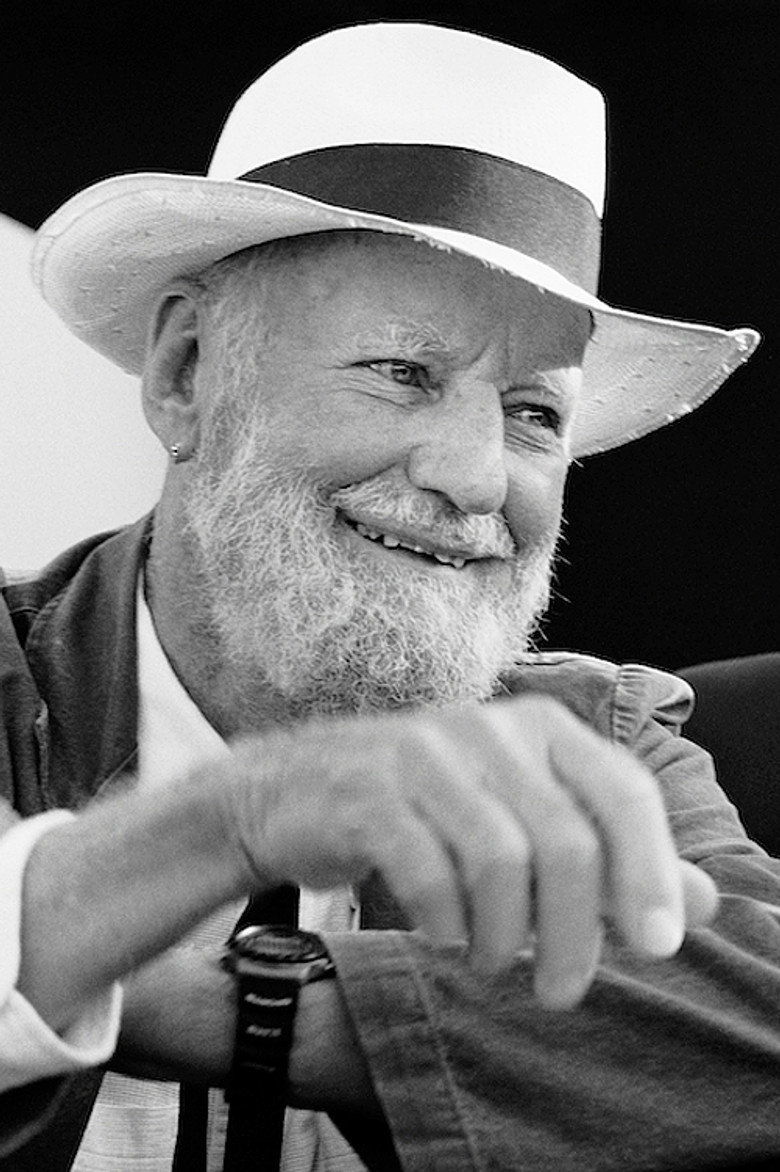
Lawrence Ferlinghetti
Lawrence Monsanto Ferlinghetti (Born Lawrence Monsanto Ferling; March 24, 1919 – February 22, 2021) was an American poet, painter and social activist
Main movies and TV shows
- The Darwin Awards (2007) — Lawrence Ferlinghetti
- The Joy of Life (2005) — Voiceover
- Fernanda Pivano: A Farewell to Beat (2001) — Se stesso
- The Beat Bomb (2022) — himself
- The War Prayer (2005) — Minister
- The Last Tears from Planet Earth (2003)
- The Beats: An Existential Comedy (1980)
- Goldmouth (1965)
- Have You Sold Your Dozen Roses? (1958) — Narrator (voice)
Facts
- Born: March 24, 1919
- Place of birth: Yonkers, United States
- Died: February 22, 2021, San Francisco, United States, aged 101
- Nationality: United States
- Birth name: Lawrence Monsanto Ferling
- Occupations: Journalist, Writer, Military officer, Poet
- Languages: English, French
- Education: University of Paris, Columbia University, University of North Carolina at Chapel Hill, Northfield Mount Hermon School, Riverdale Country School
Family
- Spouse: Selden Kirby-Smith
Detailed biography
Early life
Lawrence Monsanto Ferling was born on March 24, 1919, in Yonkers, New York.
Shortly before his birth, his father, Carlo Ferling (né Ferlinghetti), a native of Brescia, died of a heart attack; and his mother, Clemence Albertine (née Mendes-Monsanto), of Portuguese Sephardic Jewish descent, was committed to a mental hospital shortly after. Upon immigration to the United States, Carlo had shortened his surname, which Lawrence assumed and thus used it in his earlier works, until he knew his father's original surname through a birth certificate. By 1955, Lawrence reverted his surname to Ferlinghetti. Lawrence was raised by an aunt, and later by foster parents. He attended the Mount Hermon School for Boys (later Northfield Mount Hermon) graduating in 1937, then the University of North Carolina at Chapel Hill, where he earned a B.A. in journalism in 1941. He began his journalism career by writing sports for The Daily Tar Heel, and published his first short stories in Carolina Magazine, for which Thomas Wolfe had written.
He served in the U.S. Navy throughout World War II, as the captain of a submarine chaser in the Normandy invasion. In 1947, he earned an M.A. degree in English literature from Columbia University with a thesis on John Ruskin and the British painter J. M. W. Turner. From Columbia, he went to the University of Paris and earned a Ph.D. in comparative literature with a dissertation on "The City as Symbol in Modern Poetry: In Search of a Metropolitan Tradition".
City Lights
He moved to San Francisco in 1951 and founded City Lights in North Beach in 1953, in partnership with Peter D. Martin, a student at San Francisco State University. They both invested $500. In 1955 Ferlinghetti bought Martin's share and established a publishing house with the same name. The first series he published was the Pocket Poets Series. He was arrested for publishing Allen Ginsberg's Howl, resulting in a First Amendment trial in 1957, where Ferlinghetti was charged with publishing an obscene work—and acquitted.
Poetry
Ferlinghetti published many of the Beat poets and is regarded by some as a Beat poet as well. But he did not consider himself a Beat poet, as he said in the 2013 documentary Ferlinghetti: Rebirth of Wonder: "Don't call me a Beat. I never was a Beat poet."
Ferlinghetti penned much of his early poetry in the vein of T. S. Eliot. Ferlinghetti told poet and critic Jack Foley, "Everything I wrote sounded just like him." Yet even in his Eliot-inspired poems such as "Constantly Risking Absurdity", Ferlinghetti is ever the populist as he compares the poet first to a trapeze artist in a circus and then to a "little charleychaplin man."
Critics have noted that Ferlinghetti's poetry often takes on a highly visual dimension as befits this poet who was also a painter. As Jack Foley notes, Ferlinghetti's poems "tell little stories, make 'pictures'." Ferlinghetti as a poet paints with his words pictures full of color capturing the average American experience as seen in his poem "In Golden Gate Park that Day: "In Golden Gate Park that day/ a man and his wife were coming along/... He was wearing green suspenders... while his wife was carrying a bunch of grapes."
In the first poem in A Coney Island of the Mind entitled, "In Goya's Greatest Scenes, We Seem To See," Ferlinghetti describes with words the "suffering humanity" that Goya portrayed by brush in his paintings. Ferlinghetti concludes his poem with the recognition that "suffering humanity" today might be painted as average Americans drowning in the materialism: "on a freeway fifty lanes wide/ a concrete continent/ spaced with bland billboards/ illustrating imbecile illusions of happiness."
Ferlinghetti took a distinctly populist approach to poetry, emphasizing throughout his work "that art should be accessible to all people, not just a handful of highly educated intellectuals." Larry Smith, an American author and editor, stated that Ferlinghetti is a poet "of the people engaged conscientiously in the creation of new poetic and cultural forms." This perception of art as a broad socio-cultural force, as opposed to an elitist academic enterprise, is explicitly evident in Poem 9 from Pictures of the Gone World, wherein the speaker states: "'Truth is not the secret of a few' / yet / you would maybe think so / the way some / librarians / and cultural ambassadors and / especially museum directors / act" (1–8). In addition to Ferlinghetti's aesthetic egalitarianism, this passage highlights two additional formal features of the poet's work, namely, his incorporation of a common American idiom as well as his experimental approach to line arrangement which, as Crale Hopkins notes, is inherited from the poetry of William Carlos Williams.
Reflecting his broad aesthetic concerns, Ferlinghetti's poetry often engages with several non-literary artistic forms, most notably jazz music and painting. William Lawlor asserts that much of Ferlinghetti's free verse attempts to capture the spontaneity and imaginative creativity of modern jazz; the poet is noted for having frequently incorporated jazz accompaniments into public readings of his work.
Political engagement
Soon after settling in San Francisco in 1951, Ferlinghetti met the poet Kenneth Rexroth, whose concepts of philosophical anarchism influenced his political development. He self-identified as a philosophical anarchist, regularly associated with other anarchists in North Beach, and sold Italian anarchist newspapers at the City Lights Bookstore. While Ferlinghetti said he was "an anarchist at heart", he conceded that the world would need to be populated by "saints" in order for pure anarchism to be lived practically. Hence he espoused what can be achieved by Scandinavian-style democratic socialism.
In the early 1960s, Ferlinghetti was a supporter of the Fair Play for Cuba Committee. On January 14, 1967, he was a featured presenter at the Gathering of the tribes "Human Be-In", which drew tens of thousands of people and launched what would become known as San Francisco's "Summer of Love". In 1968, Ferlinghetti signed the "Writers and Editors War Tax Protest" pledge, vowing to refuse to pay his Federal income tax as a protest against the Vietnam War.
In 1998, in his inaugural address as Poet Laureate of San Francisco, Ferlinghetti urged San Franciscans to vote to remove a portion of the earthquake-damaged Central Freeway and replace it with a boulevard: "What destroys the poetry of a city? Automobiles destroy it, and they destroy more than the poetry. All over America, all over Europe in fact, cities and towns are under assault by the automobile, are being literally destroyed by car culture. But cities are gradually learning that they don't have to let it happen to them. Witness our beautiful new Embarcadero! And in San Francisco right now we have another chance to stop Autogeddon from happening here. Just a few blocks from here, the ugly Central Freeway can be brought down for good if you vote for Proposition E on the November ballot."
Painting
Alongside his bookselling and publishing, Ferlinghetti painted for 60 years and much of his work was displayed in galleries and museums throughout the United States.
Ferlinghetti painted The beautiful Madonna of Sandusky Oh! hi! O! And friend during a 1996 visit to an art co-op in Sandusky, Ohio, which was subsequently vandalized and censored by a janitor the night after it was painted. Ferlinghetti responded to this act by painting a humorous retort on areas of the canvas where censorship had occurred.
A retrospective of Ferlinghetti's artwork, 60 Years of Painting, was staged in Rome and Reggio Calabria in 2010.
Jack Kerouac Alley
In 1987, he was the initiator of the transformation of Jack Kerouac Alley, located at the side of his shop. He presented his idea to the San Francisco Board of Supervisors calling for repavement and renewal.
Death
Ferlinghetti died of interstitial lung disease on February 22, 2021, at his home in San Francisco, a month before his 102nd birthday. He was buried in his family plot at Bolinas Cemetery in Bolinas, California.
In popular culture
Frank Zappa namedropped Lawrence Ferlinghetti as one of the people who influenced his band's music, in the sleeve of his debut album Freak Out! (1966).
Ferlinghetti recited the poem Loud Prayer at The Band's final performance; the concert was filmed by Martin Scorsese and released as a documentary entitled The Last Waltz (1978), which included Ferlinghetti's recitation. Andrew Rogers played Ferlinghetti in the 2010 film Howl. Ferlinghetti was the subject of the 2013 Christopher Felver documentary, Lawrence Ferlinghetti: A Rebirth of Wonder.
In 2011, Ferlinghetti contributed two of his poems to the celebration of the 150th anniversary of Italian unification, Song of the Third World War and Old Italians Dying inspired by the artists of the exhibition Lawrence Ferlinghetti and Italy 150 held in Turin, Italy (May–June 2011). On the book of lithographs The Sea Within Us first published in Italy as Il Mare Dentro in 2012, Ferlinghetti collaborated with lithographer and abstract artist James Claussen. Julio Cortázar, in his Rayuela (Hopscotch) (1963), references a poem from A Coney Island of the Mind in Chapter 121.
Personal life
Ferlinghetti met his wife-to-be, Selden Kirby-Smith, the granddaughter of Edmund Kirby-Smith, in 1946 aboard a ship en route to France. They were both heading to Paris to study at the Sorbonne. Kirby-Smith went by the nickname Kirby. Their marriage produced two children before ending in divorce.
Source: Wikipedia — Text licensed under CC BY-SA 4.0