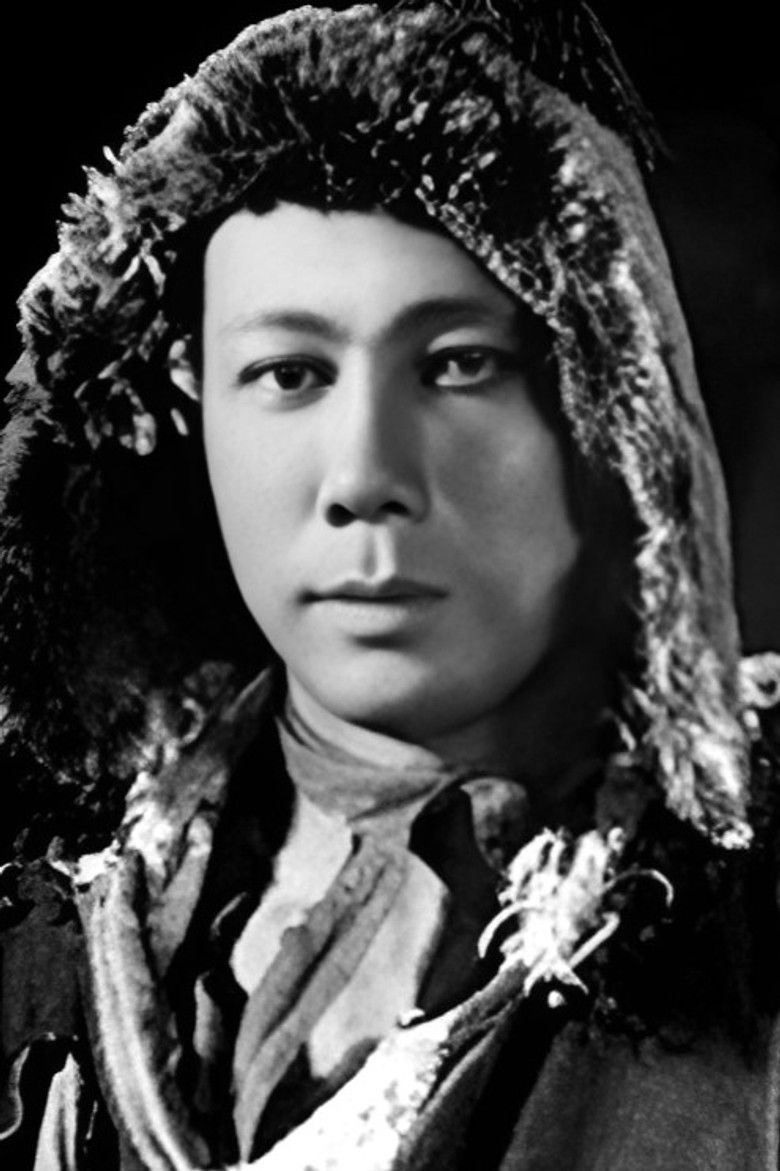
Valéry Inkijinoff
Valéry Inkijinoff (Russian: Валерьян (Валерий) Иванович Инкижинов; 25 March 1895 – 26 September 1973) was a French actor of Russian-Buryat origin. His strong facial features made him a favourite villain of French cinema for exotic adventure films and crime movies. Inkijinoff was born to a Christian Buryat father and a Russian mother in Irkutsk gubernia. He studied at the Polytechnical Institute of Saint Petersburg and was for a time one of the resident actors of an imperial theater of this city. At the beginning of his career in Russia, he appeared first as stuntman in a few movies and then as director and as actor. His major lead role during the Russian part of his career is The Son in Storm Over Asia by Vsevolod Pudovkin in 1928, a major Soviet propaganda film about a fictional British consolidation of Mongolia. He was also an actor in the troop of Vsevolod Meyerhold and was then appointed as director of the movie and theater school of Kiev in Ukraine. In 1930, while in France on a European tour, he refused to return to the USSR. According to Boris Shumyatsky, after Stalin learned Inkijinoff had never returned in 1934, said: "Too bad that the man escaped. Now he, probably, is dying to come back but, alas, too late." He starred in 2 movies while living in the Soviet Union, and contrary to Stalin's assumption, Inkijinoff became immensely popular in Europe, arguably the most successful Soviet actor abroad, starring in a total of 44 French, British, German, and Italian films. In France he frequently played the part of Asian villains. His most active period was in the thirties, when he appeared in Les Bateliers de la Volga and the G. W. Pabst film Le drame de Shanghai. He played for Fritz Lang in 1959, in Der Tiger von Eschnapur and its sequel Das indische Grabmal, in which he played the role of the high priest Yama. In 1965, Philippe de Broca cast him as Monsieur Goh, the wise but scary Chinese who guarantees to the Jean-Paul Belmondo character a certain death in Les tribulations d'un Chinois en Chine. His last movie was with Brigitte Bardot and Claudia Cardinale, where he played the role of Indian chief Spitting Bull in Les pétroleuses. He was a great friend of Charles Dullin and Louis Jouvet, and had a long career in French theater, appearing for instance in Marie Galante by Jacques Deval. He died at his home in Brunoy, Essonne, France, aged 78. Source: Article "Valéry Inkijinoff" from Wikipedia in English, licensed under CC-BY-SA 3.0.
Main movies and TV shows
- Up to His Ears (1965) — Mr. Goh
- The Tiger of Eschnapur (1959) — Yama
- The Last Adventure (1967) — Kyobaski, producer
- The Indian Tomb (1959) — Yama
- Storm Over Asia (1928) — Bair
- The Legend of Frenchie King (1971) — Spitting Bull
- O.S.S. 117: Mission to Tokyo (1966) — Yekota
- Michael Strogoff (1956) — Feofar Khan
- A Man's Head (1933) — Radek
- The Blonde from Peking (1967) — Fang Ho Kung
- The Biggest Bundle of Them All (1968) — Mafia Guy in Sauna (uncredited)
- Maya (1949) — Cachemire
- The Death Ray of Dr. Mabuse (1964) — Dr. Krishna
- Amok (1934) — Maté / Amok-afflicted Native
- Samson and the 7 Miracles of the World (1961) — High Priest
- The Shanghai Drama (1938) — Lee Pang
- Matchless (1967)
- The Triumph of Michael Strogoff (1961) — Yusuf Ben Amektal
- Journey to the Lost City (1960) — Yama, High Priest
- Volga in Flames (1934) — Silatschoff
Facts
- Born: March 25, 1895
- Place of birth: Bokhan, Russia
- Died: September 26, 1973, Brunoy, France, aged 78
- Nationality: France, Russian Empire
- Birth name: Валерий Иванович Инкижинов
- Occupations: Director, Actor
- Languages: French
- Education: Peter the Great Saint Petersburg State Polytechnical University
Detailed biography
Early life
Inkijinoff was born in Bokhan, Irkutsk Governorate to a Christian Buryat father and an ethnic Russian mother. He studied at the Polytechnical Institute of Saint Petersburg, and for a time one of the resident actors of an imperial theater of the city. He studied acting under Vsevolod Meyerhold, where he helped develop the rehearsal technique of biomechanics. He joined Meyerhold's troupe in Moscow, where he also studied with Lev Kuleshov.
Career
At the beginning of his career in Russia, he appeared first as stuntman in a few movies and then as director and as actor. His major lead role during the Russian part of his career is Bair in Storm Over Asia by Vsevolod Pudovkin in 1928, a major Soviet propaganda film about a fictional British consolidation of Mongolia. He was also an actor in the troop of Vsevolod Meyerhold and was then appointed as director of the movie and theater school of Kiev.
In 1930, while in France on a European tour, he refused to return to the USSR. According to Boris Shumyatsky, after Stalin learned Inkijinoff had never returned in 1934, said: "Too bad that the man escaped. Now he, probably, is dying to come back but, alas, too late." He starred in 2 movies while living in the Soviet Union, and contrary to Stalin's assumption, Inkijinoff became immensely popular in Europe, arguably the most successful Soviet actor abroad, starring in a total of 44 French, British, German, and Italian films.
In France he frequently played the part of Asian villains. His most active period was in the thirties, when he appeared in Les Bateliers de la Volga and the G. W. Pabst film Le drame de Shanghai. He played for Fritz Lang in 1959, in Der Tiger von Eschnapur and its sequel Das indische Grabmal, in which he played the role of the high priest Yama. In 1965, Philippe de Broca cast him as Monsieur Goh, the wise but scary Chinese who guarantees to the Jean-Paul Belmondo character a certain death in Les tribulations d'un Chinois en Chine.
His last movie was with Brigitte Bardot and Claudia Cardinale, where he played the role of a Native American chieftain in Les pétroleuses.
Personal life
He was a great friend of Charles Dullin and Louis Jouvet, and had a long career in French theater, appearing for instance in Marie Galante by Jacques Deval.
Death
Inkijinoff died at his home in Brunoy, Essonne, France, aged 78. He is buried at Sainte-Geneviève-des-Bois Russian Cemetery
Source: Wikipedia — Text licensed under CC BY-SA 4.0